São Paolo: Faculty of Architecture (FAU-USP) (Stop 1 of 8)
“Spatialization of democracy” – no better way to start the day than on stop 1 of 8 on this epic tour curated off of Insight Architecture’s Brutalism and Paulista School tour (of which we did not go to Residência João Marino (CAMP) by Sylvio Sawaya or Glass House by Lina Bo Bardi – note to future self- but many others). The Faculdade de Arquitetura e Urbanismo (FAU-USP) is the heart of Brazilian Brutalism in São Paolo and no better architect to speak of than its architect João Batista Vilanova Artigas. Similar to Neimeyer, Artigas was also a political activist- at the end of this post you will find more information about this important example of how architecture becomes a matter of interpretation and representation Gemini 3.1 Pro (Mar 7, 2026).
I’ve decided to demonstrate the points so eloquently, succinctly and meaningfully raised by our architect tour guide than any LLM could have, though an LLM has sure filled in the gaps. Place is a fundamental expression of our existence and to have been in this place learning, as the architect intended, there is no greater honor than to fulfill on that promise.
As I wrote the below- here’s the poem that formed:
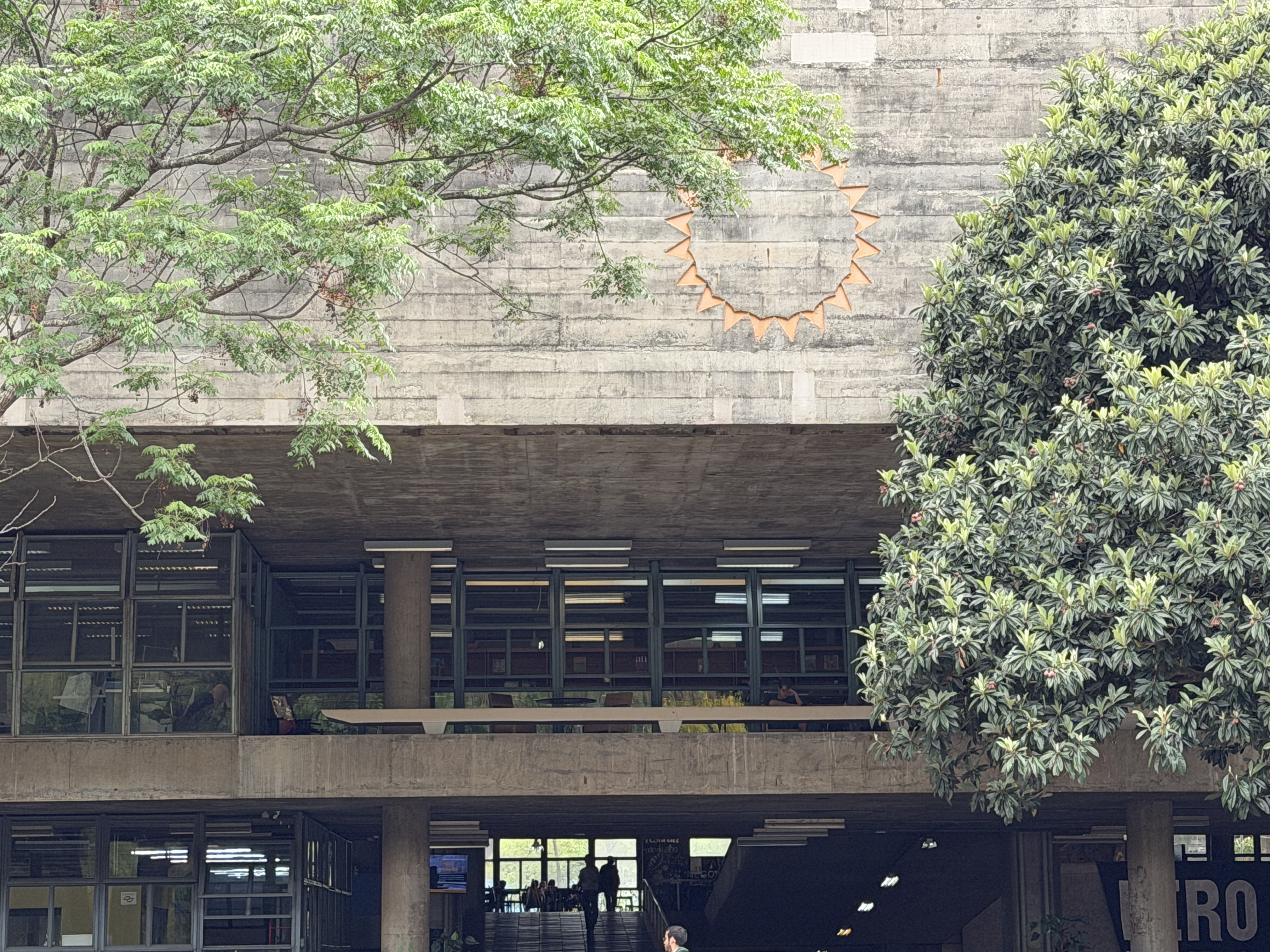
No door, the sun.
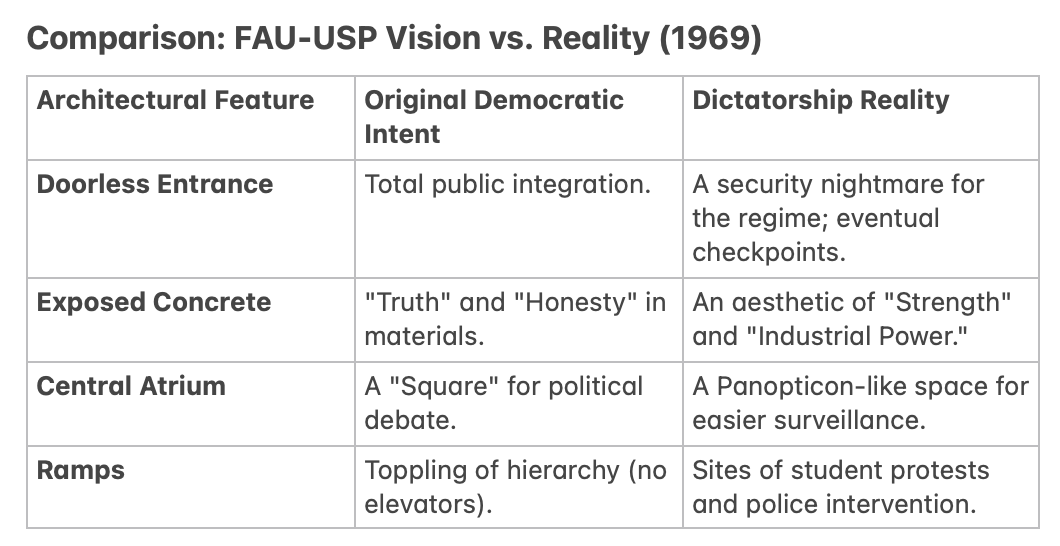
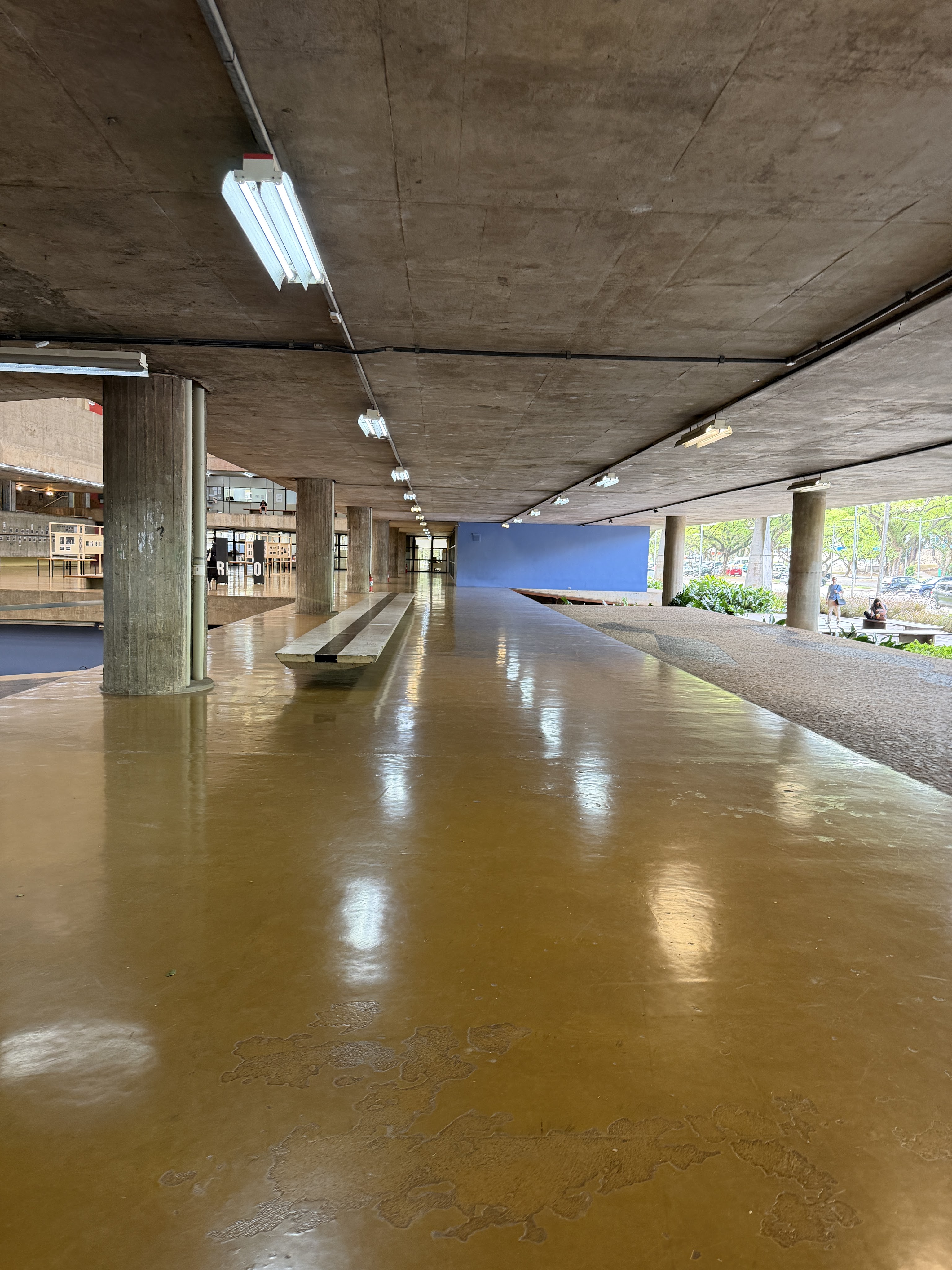
Artigas famously designed the building without an entrance door. The ground floor (the piazza) was intended to be a continuous extension of the sidewalk. This was a literal architectural translation of “public space” and “free access to knowledge.”
“So long as the connection between architects and the popular masses does not settle or organize, as long as the work of architects has not the glory of being discussed in factories and farms, there will be no popular architecture.”
Source: Artigas, J. B. V. (1952). Os caminhos da arquitetura moderna (The Paths of Modern Architecture). Reprinted in Caminhos da Arquitetura (1981).
While I found plenty of concrete (pun intended as concrete itself is the of much contention here) information on this door-less policy, I could not about the sun above the doorway. I noticed the sun at the end of the visit, while we were waiting a bit to organize the timing on our next stop and asked because with formed concrete, that sun would not have been an afterthought but a forethought. Notes on concrete later.
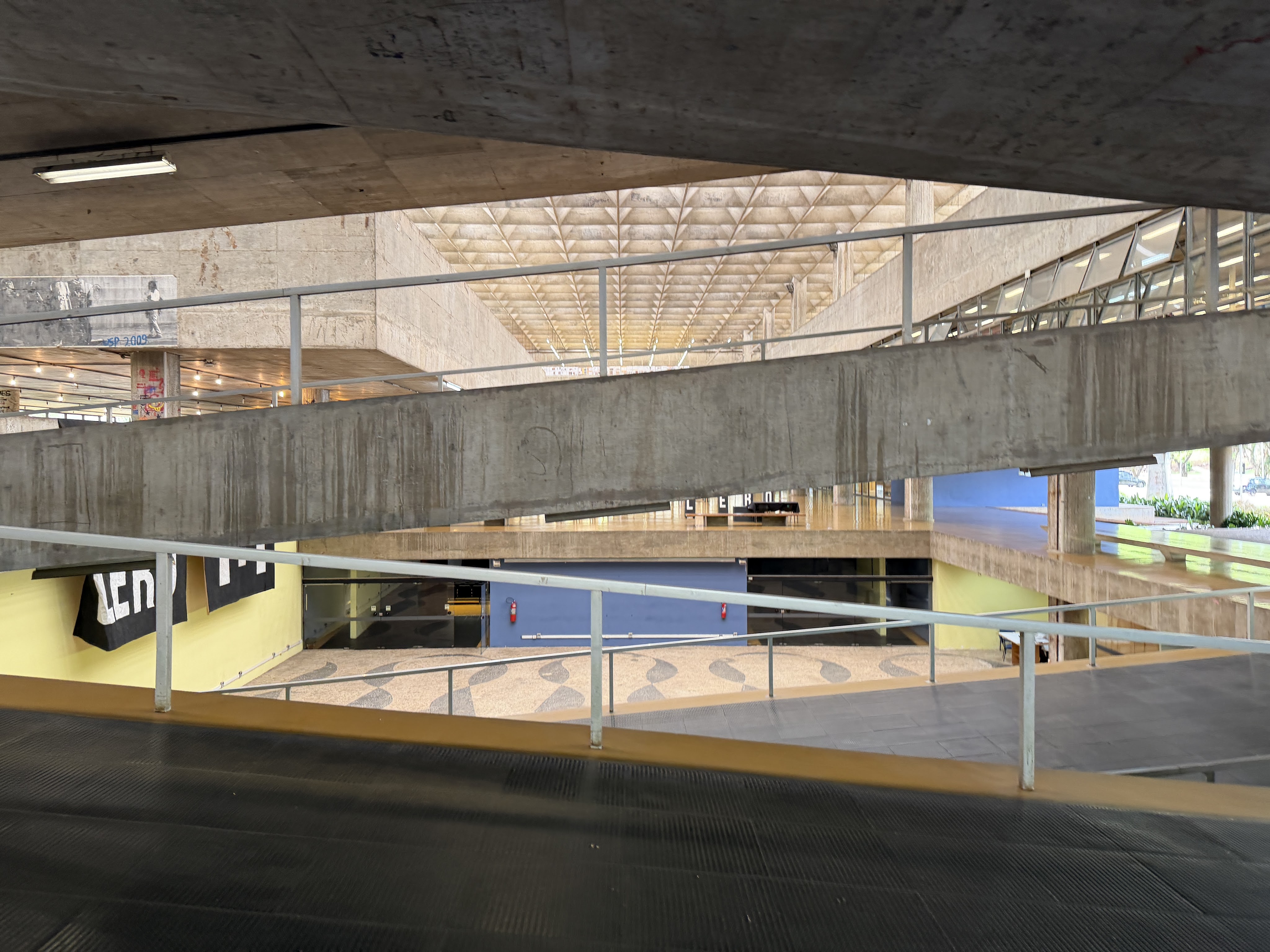
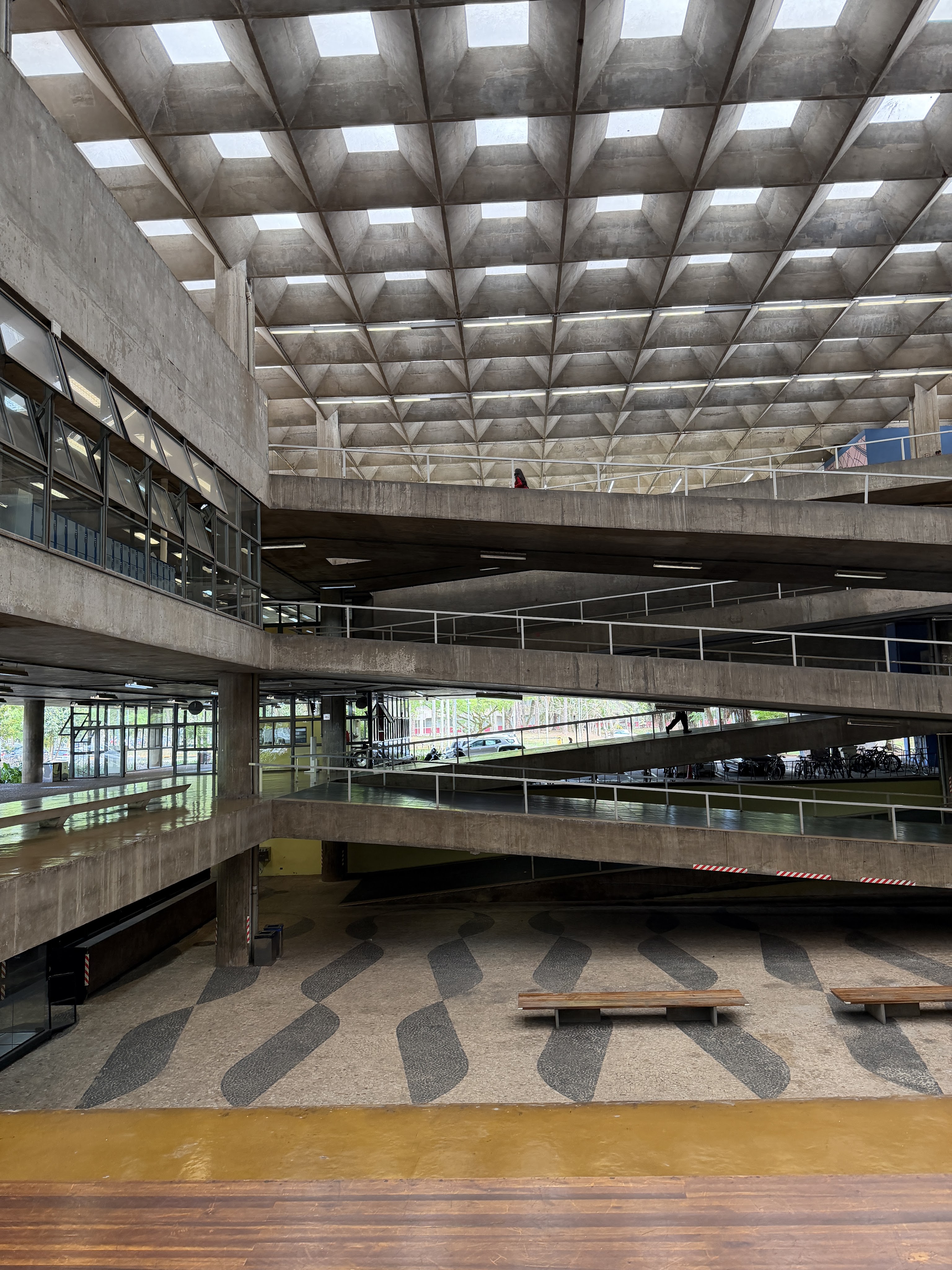
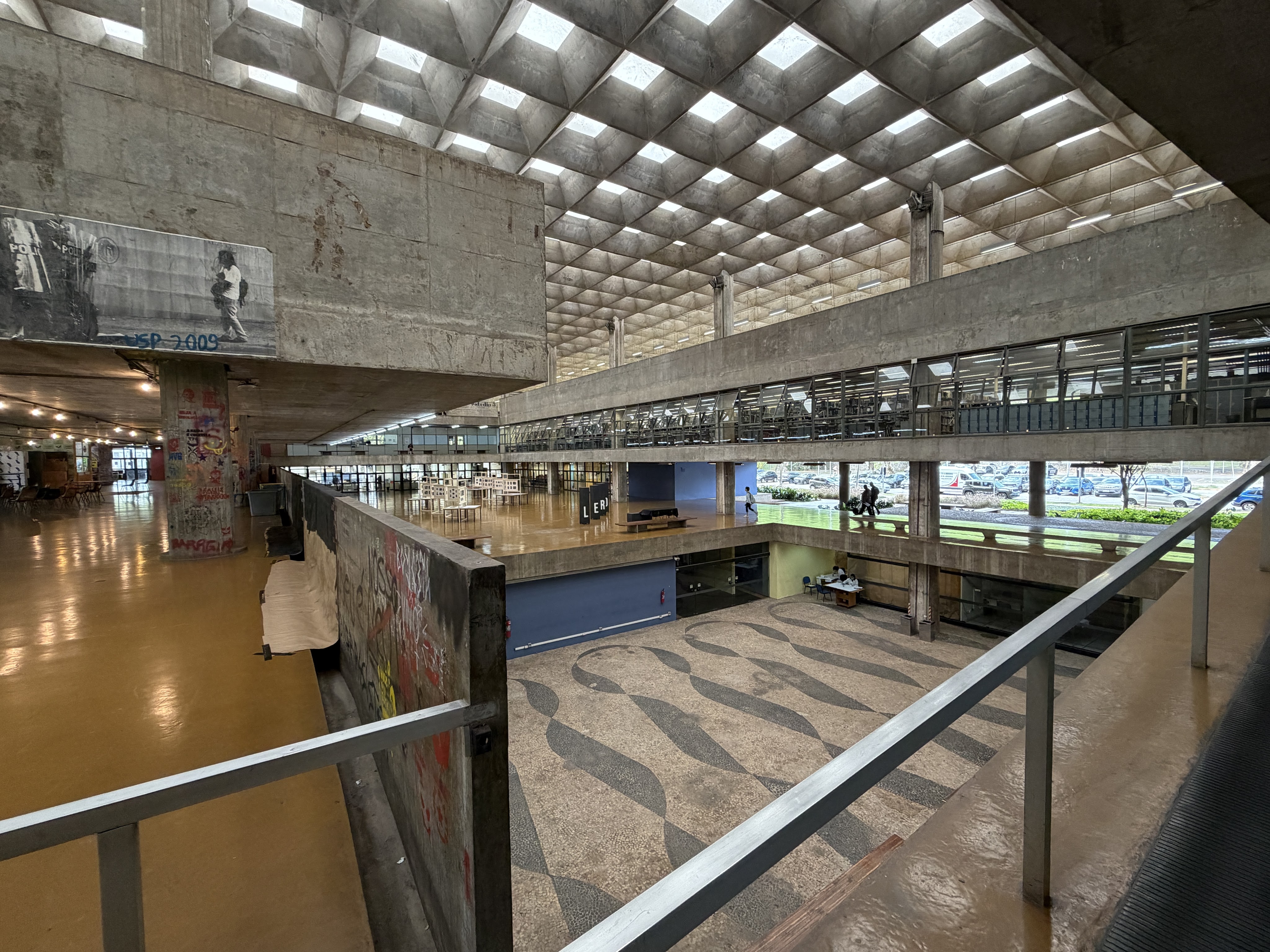
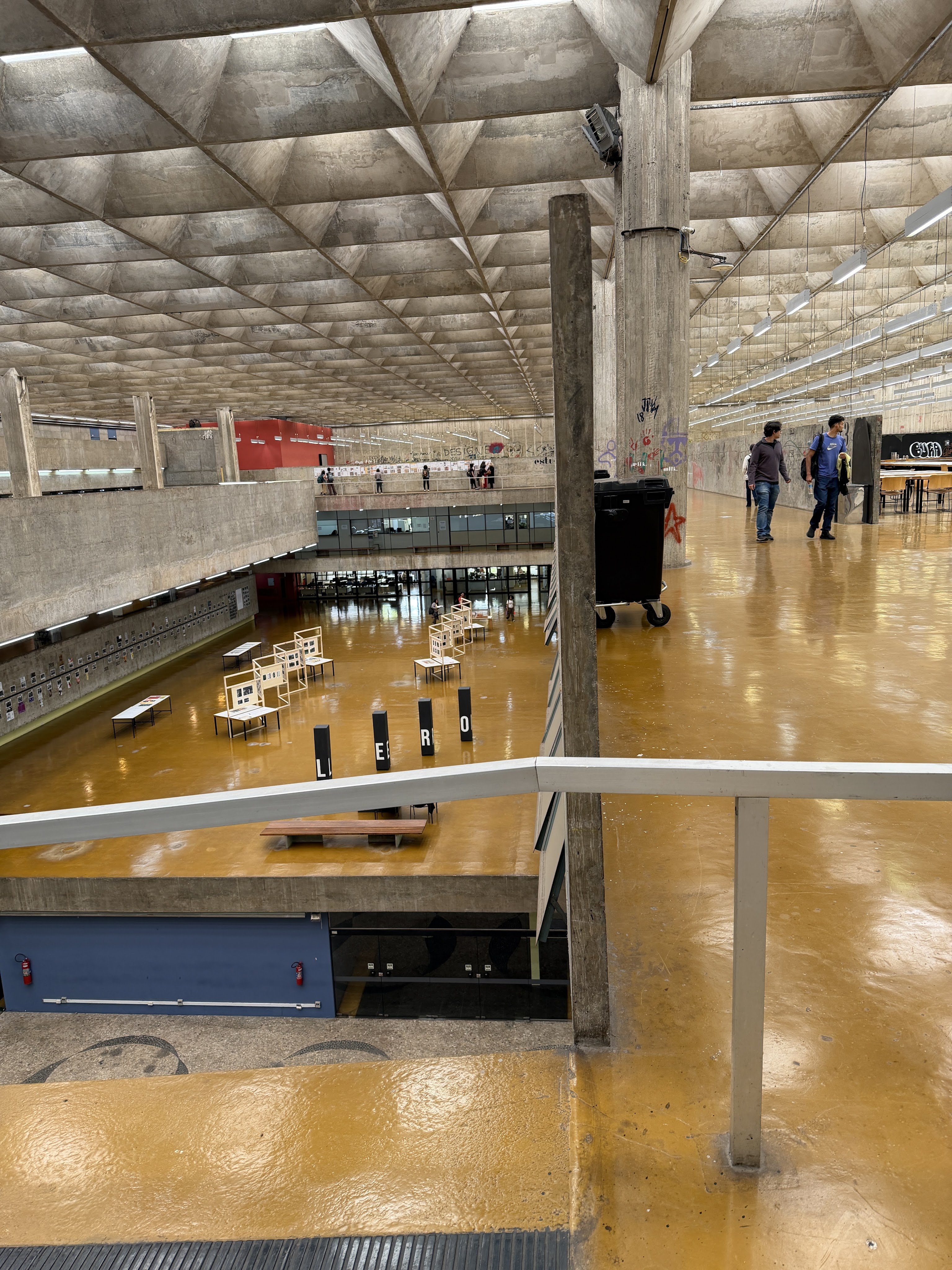
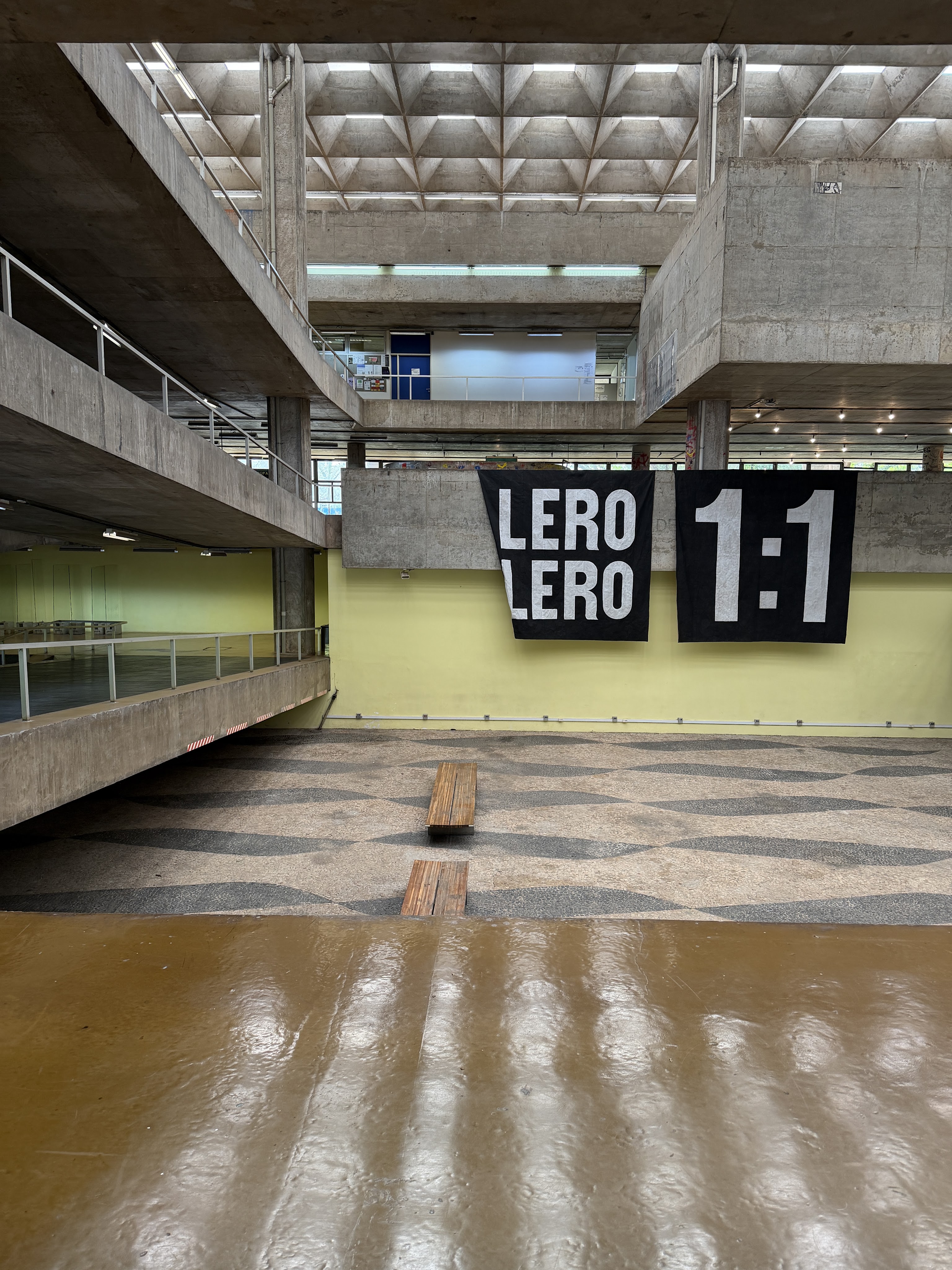
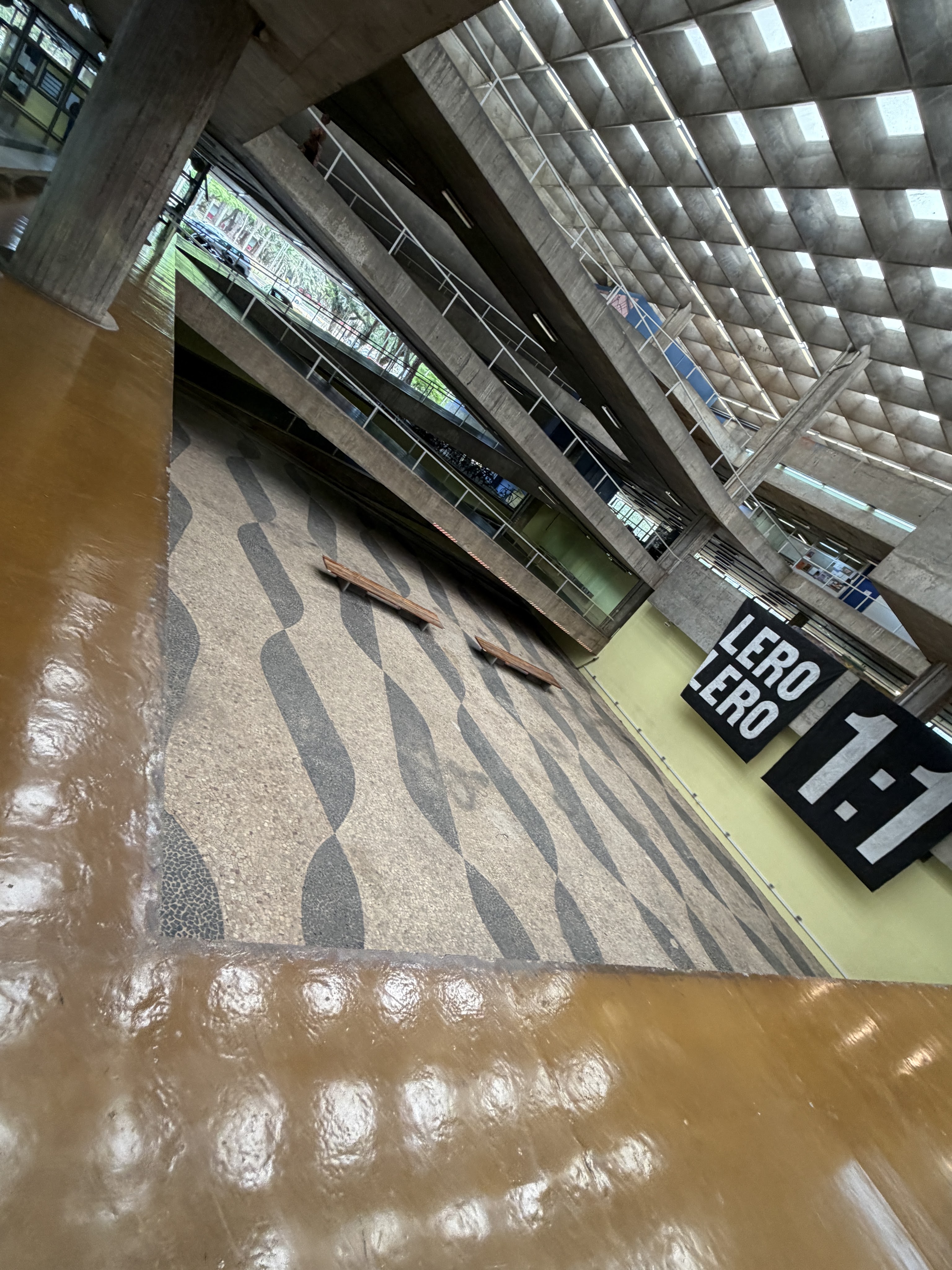
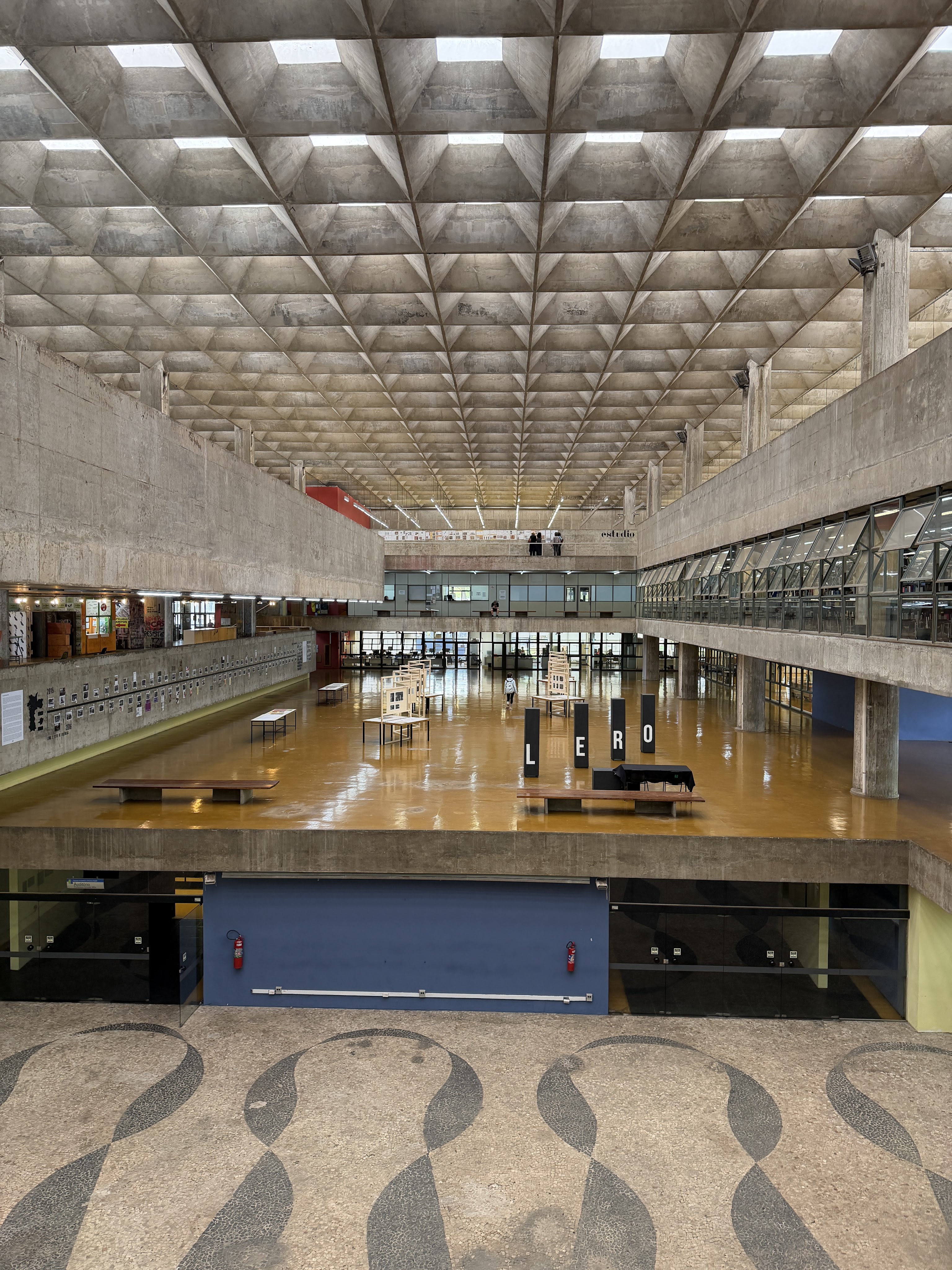
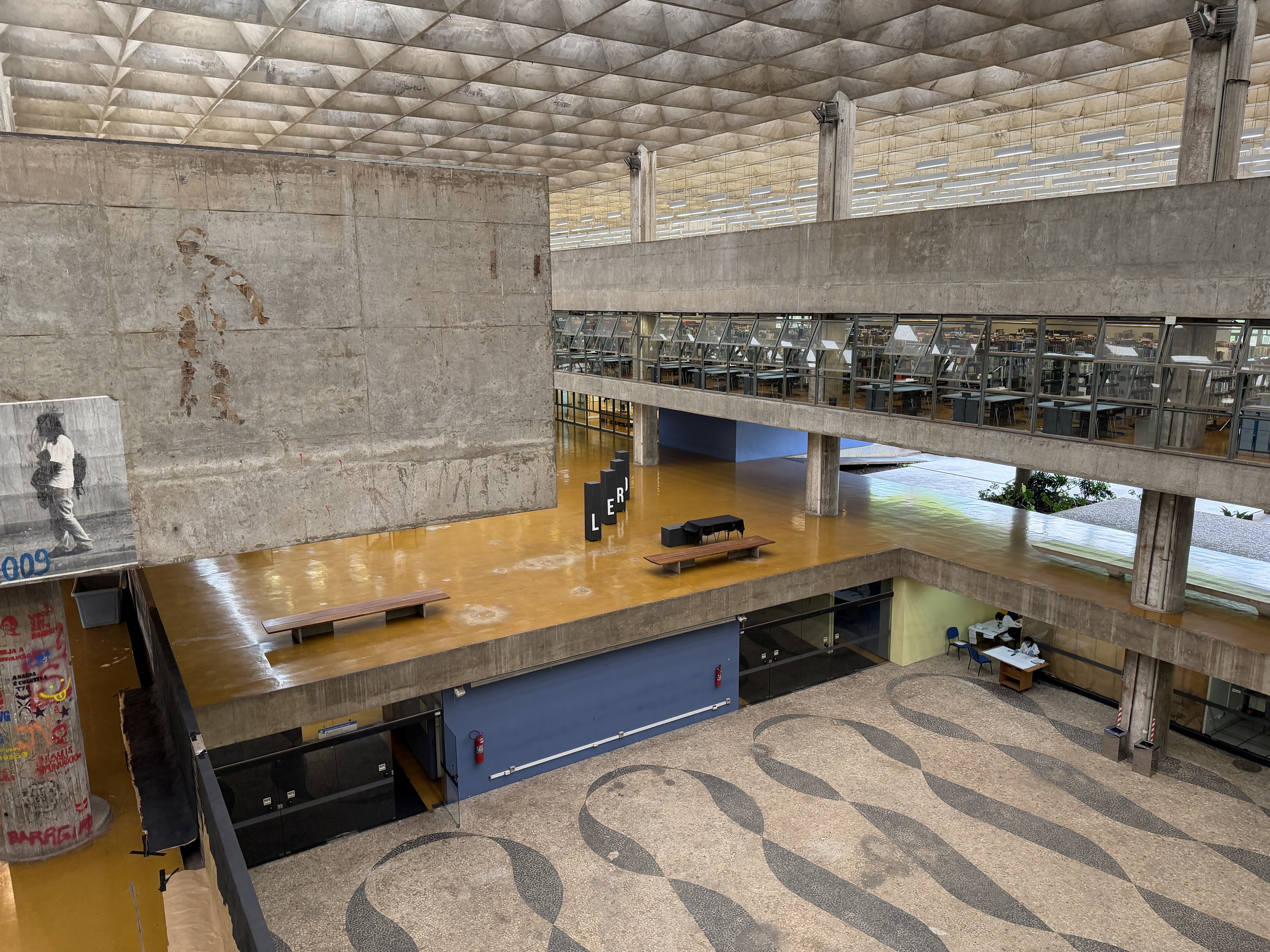
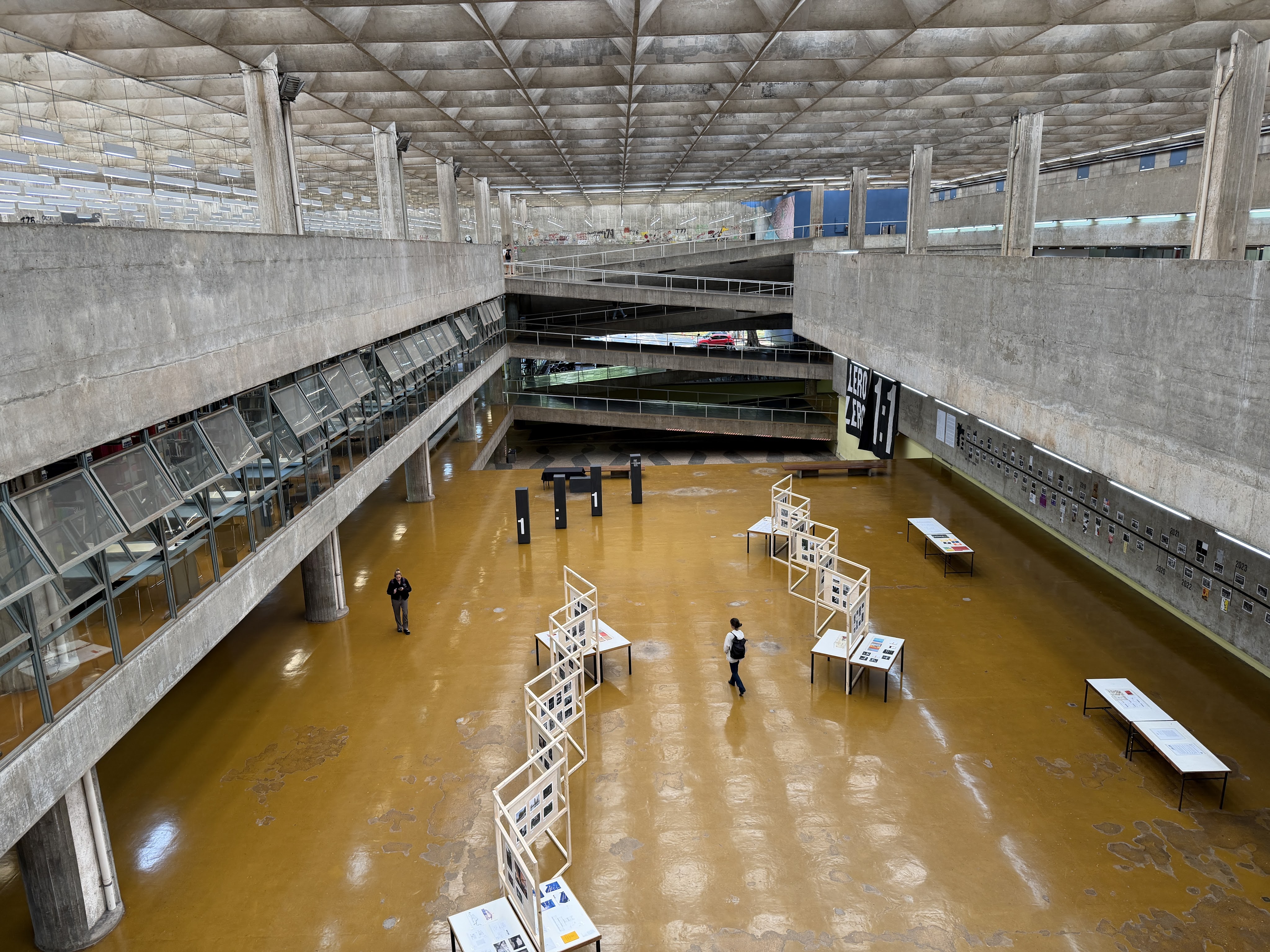
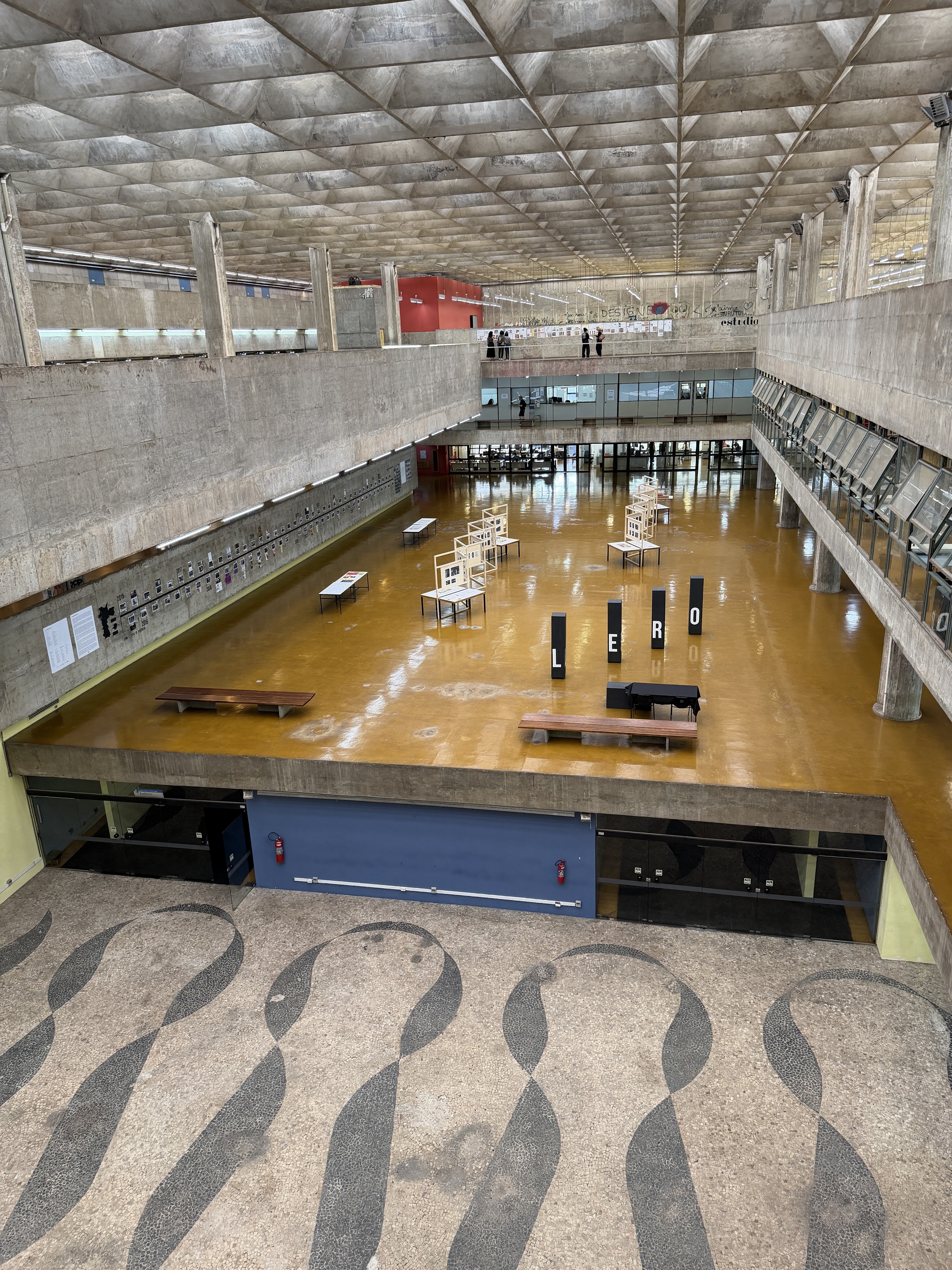
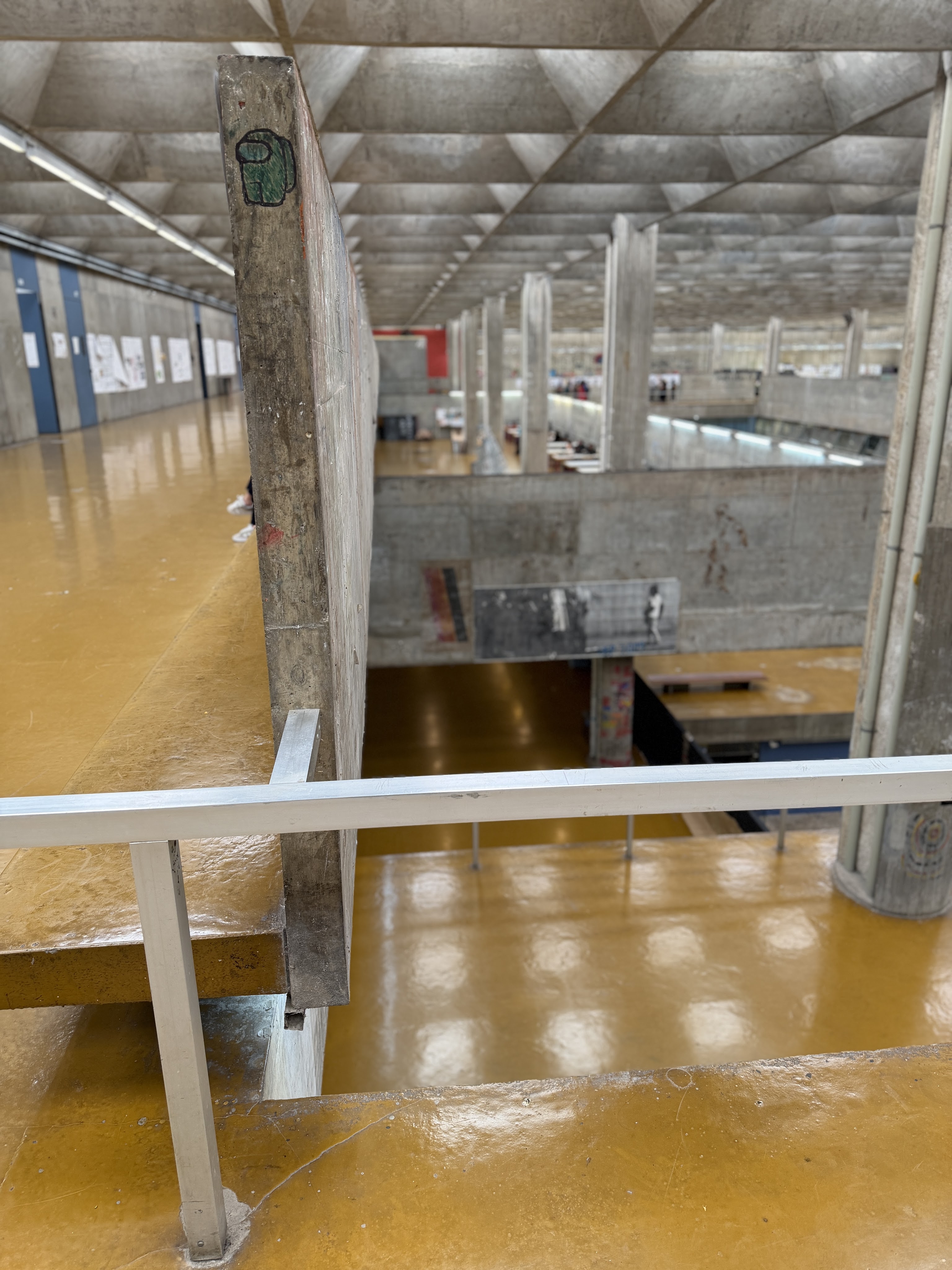
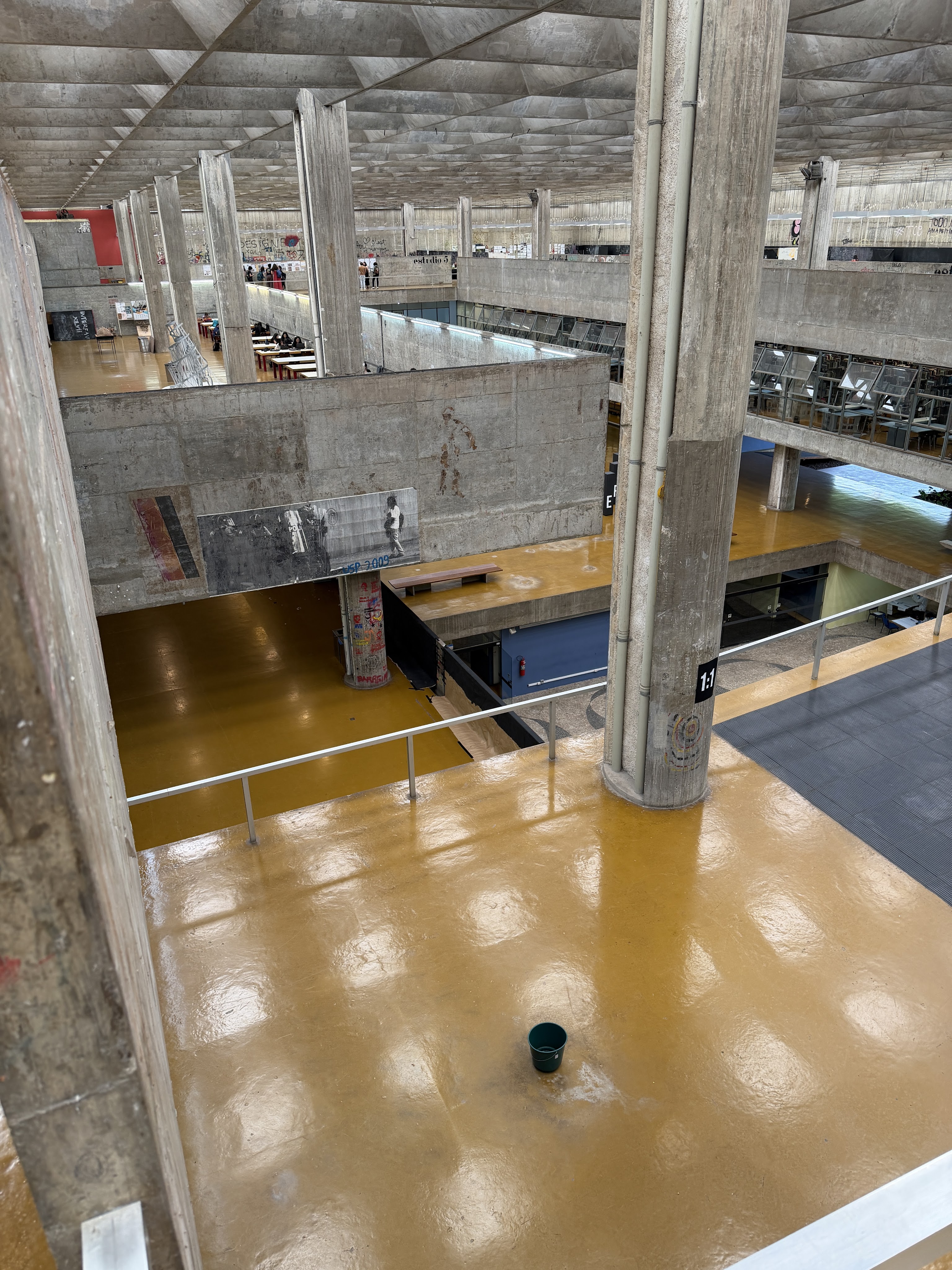
Central atrium. From the doorless entry into this massive space. Multiple layers interweaving open spaces with a serious lack of railings (but this is also thematic in the other Brutalist builds we went to see). The scale of this place is jaw dropping- you can feel how the energy passes through the space(s), intermingling just as Artigas designed it for- and in the power of these, we can see it how easily humans can twist togetherness:
The open, doorless design that Artigas intended for democracy became a liability under the dictatorship. The “Great Void” in the center, designed for debate and to force students and professors from different years and disciplines to see one another, fostering a “transparent” and non-hierarchical academic community- became a place where the military police could easily monitor student assemblies from the ramps above.
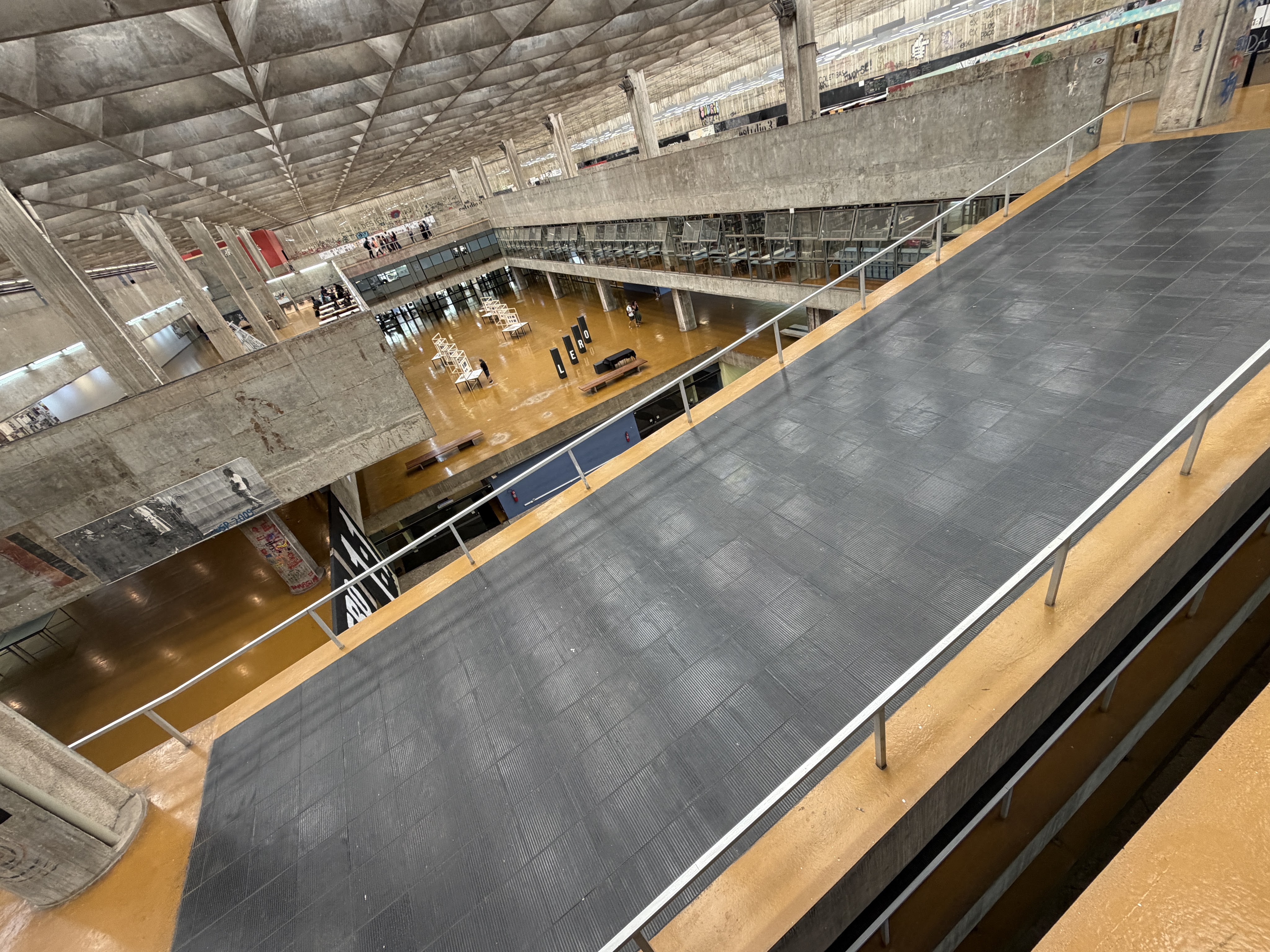
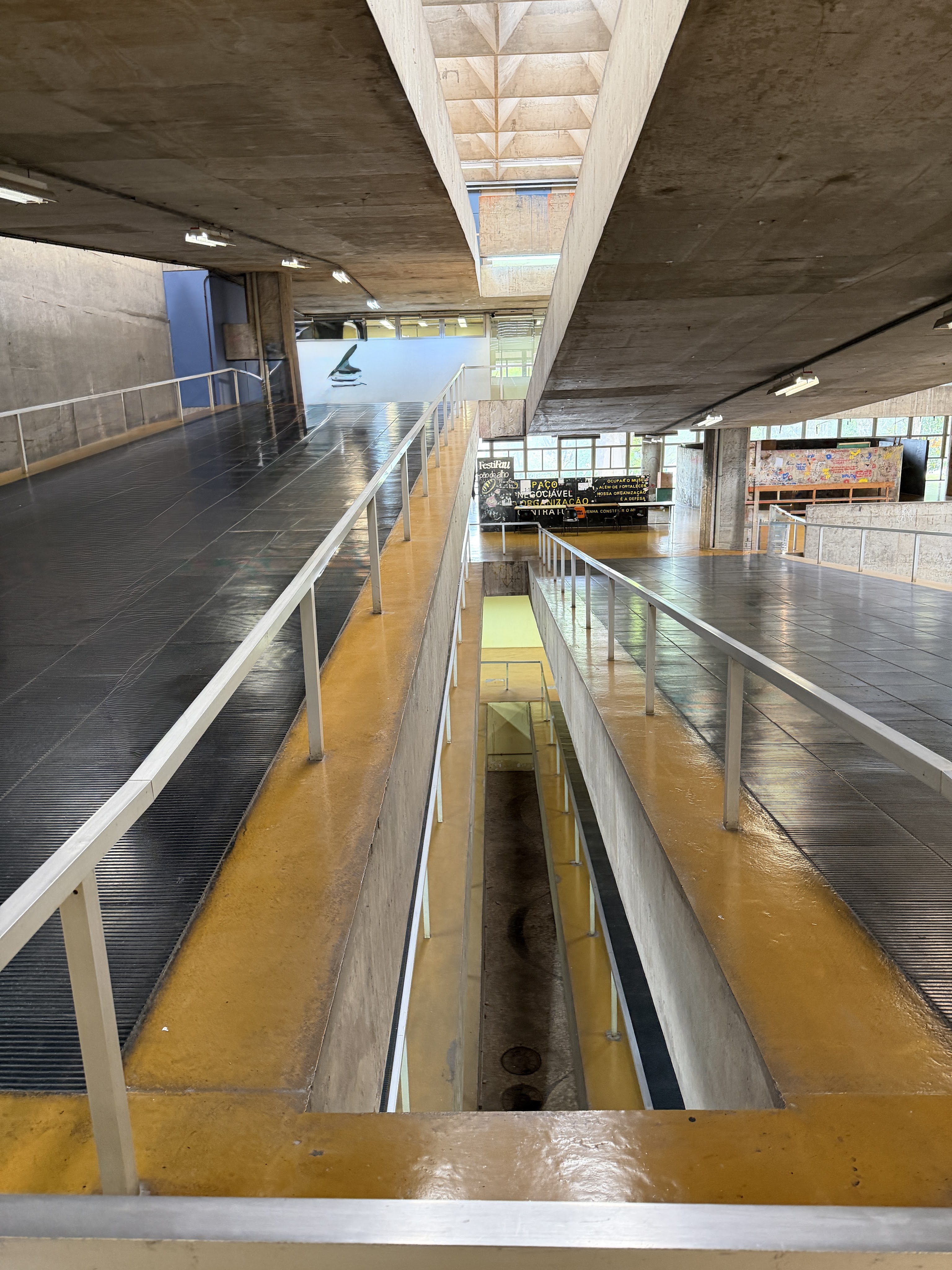
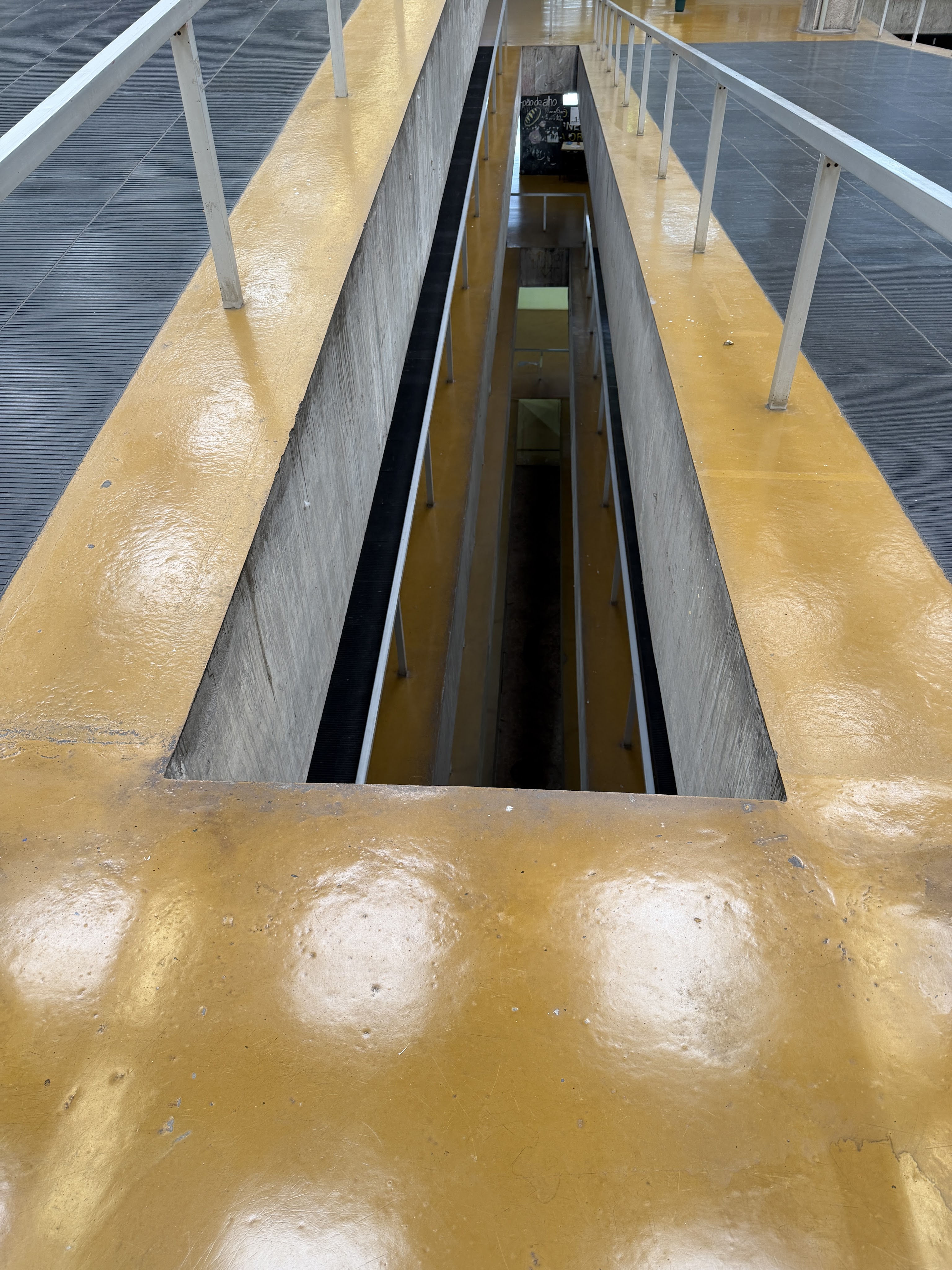
The ramps. From the doorless entry into this massive space and traversing the ramps.
Instead of traditional stairs or elevators, the six levels of the building are connected by wide, continuous ramps to encourage fluid movement and spontaneous meetings between students and teachers. The ramps are designed for fluid movement and “democratic encounters.”
Besides concrete, though the shapes they form differ between the Rio and São Paolo styles, ramps are a definite common theme across these approaches of Brutalism. There’s something about the importance of a journey.
In Brazilian Brutalism, the “journey” is known as the Promenade Architecturale—a concept borrowed from Le Corbusier but radicalized by the Paulista School to be more rugged, public, and politically charged.
For architects like Artigas and Mendes da Rocha, the journey wasn’t just about moving from Point A to Point B; it was about the experience of gravity, light, and community.
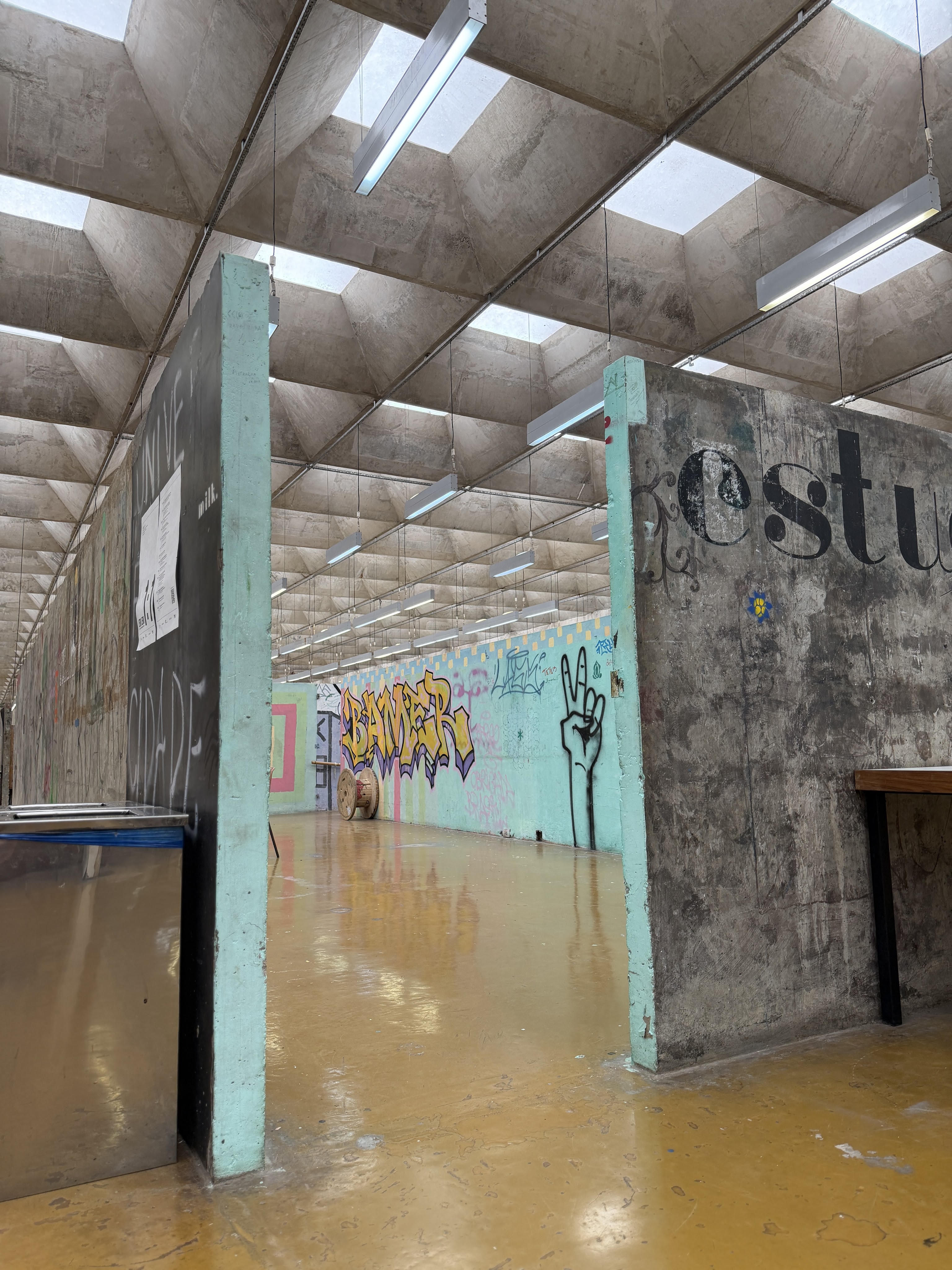
The roof. From the doorless entry into this massive space and traversing the ramps to the top floor to see the continuous source of light.
Philosophically:
A vast, roofed courtyard designed to host political and cultural events. It is naturally lit through a grid of concrete pyramidal “skylights” (domes) that bathe the central courtyard in natural light.
“I don’t build walls; I build horizons.”
Source: Attributed to Artigas during the design of the FAU-USP building (1961), referring to the open-plan, “doorless” nature of the school.
No one office or classroom had a “better view” or better light than another. Everyone studied under the same sun, reflected off the same raw concrete.
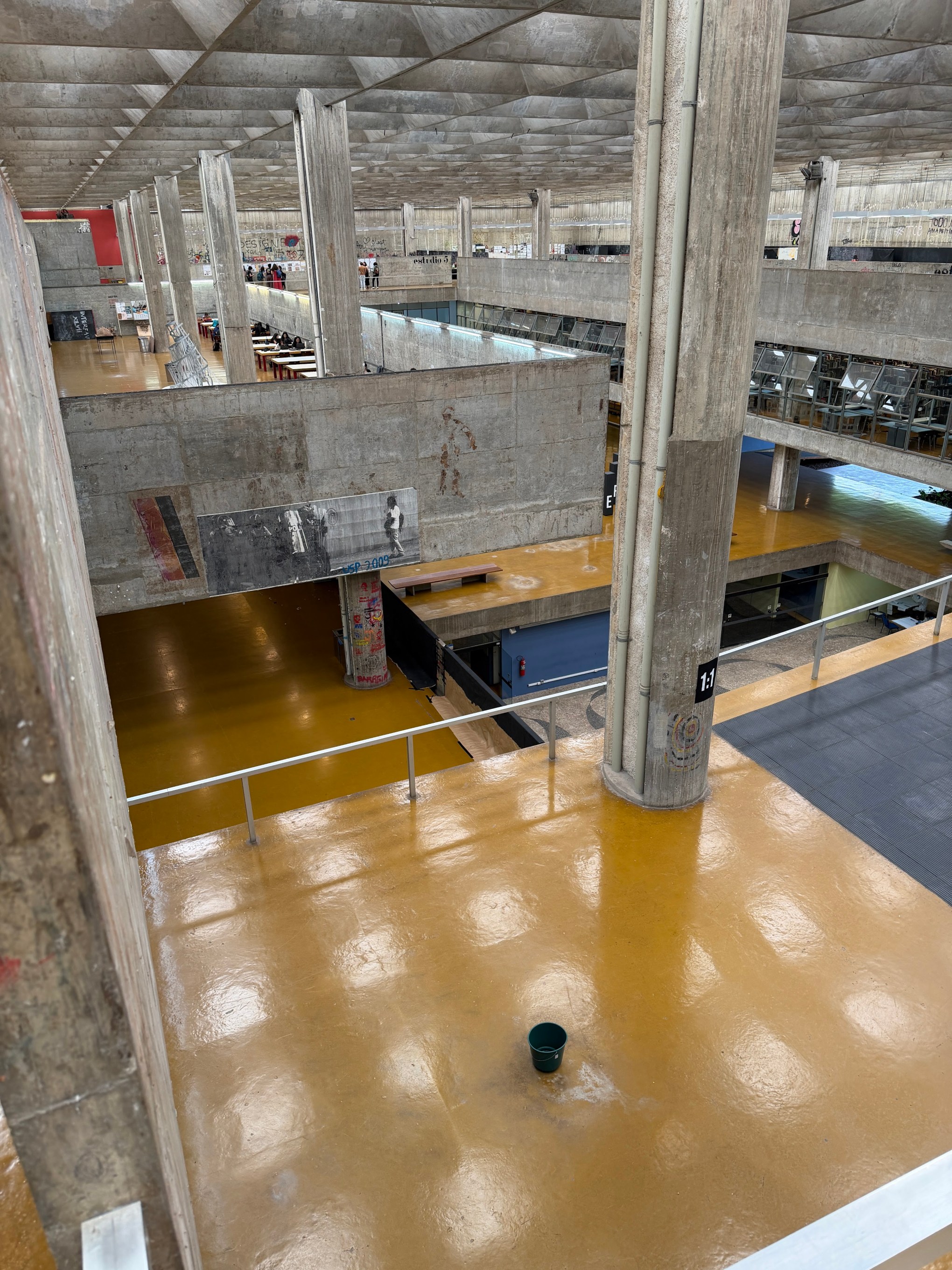
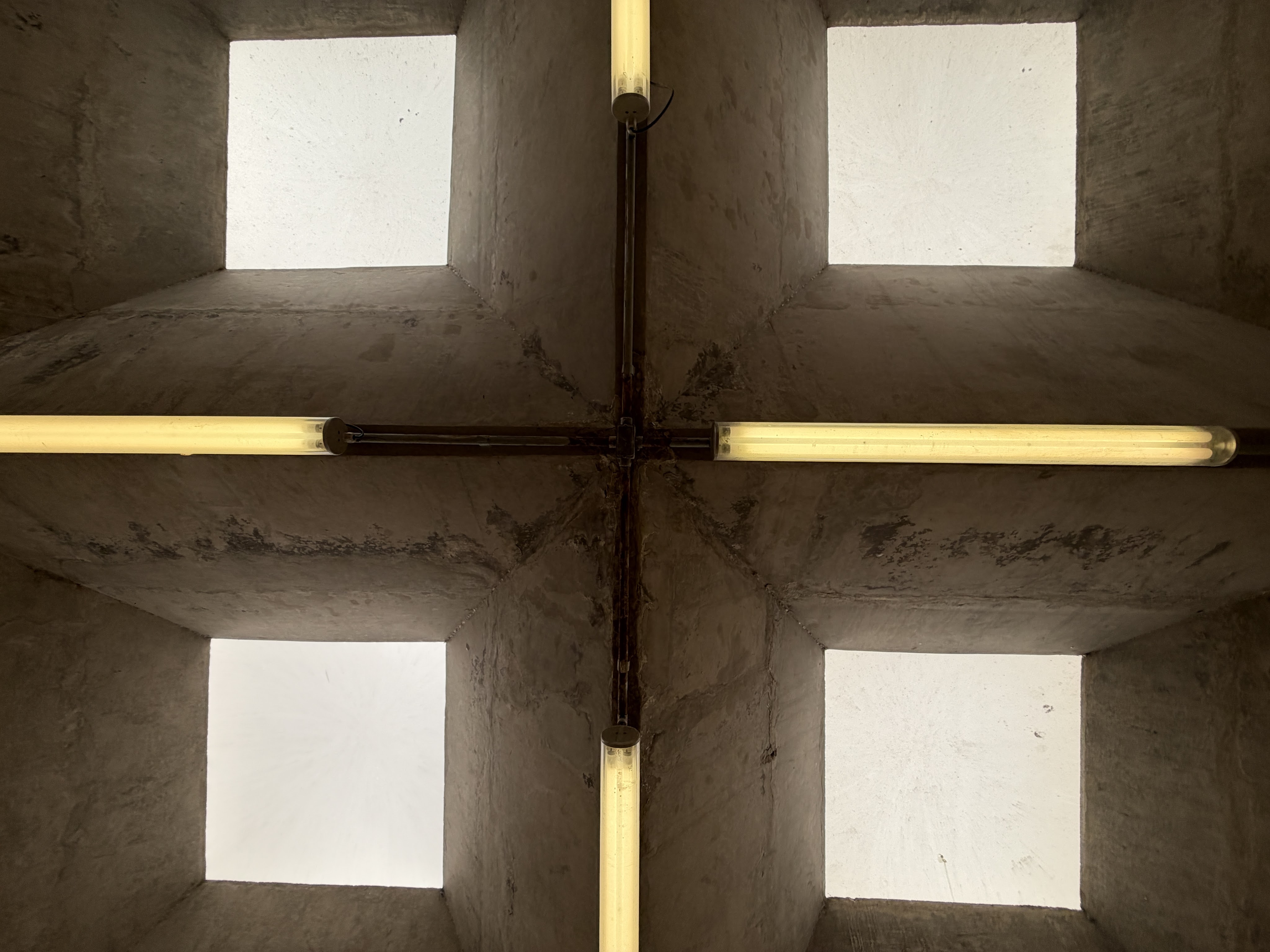
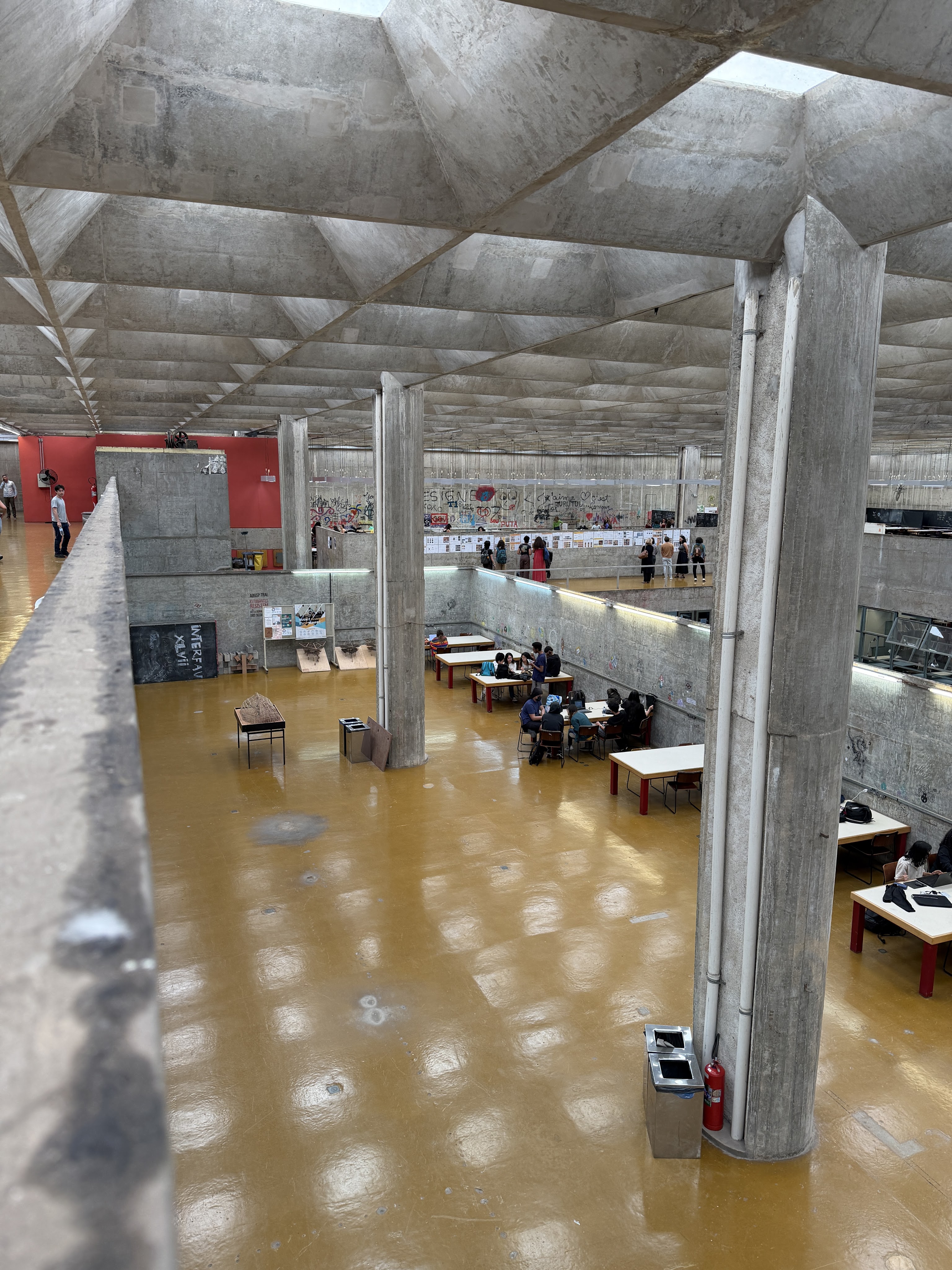
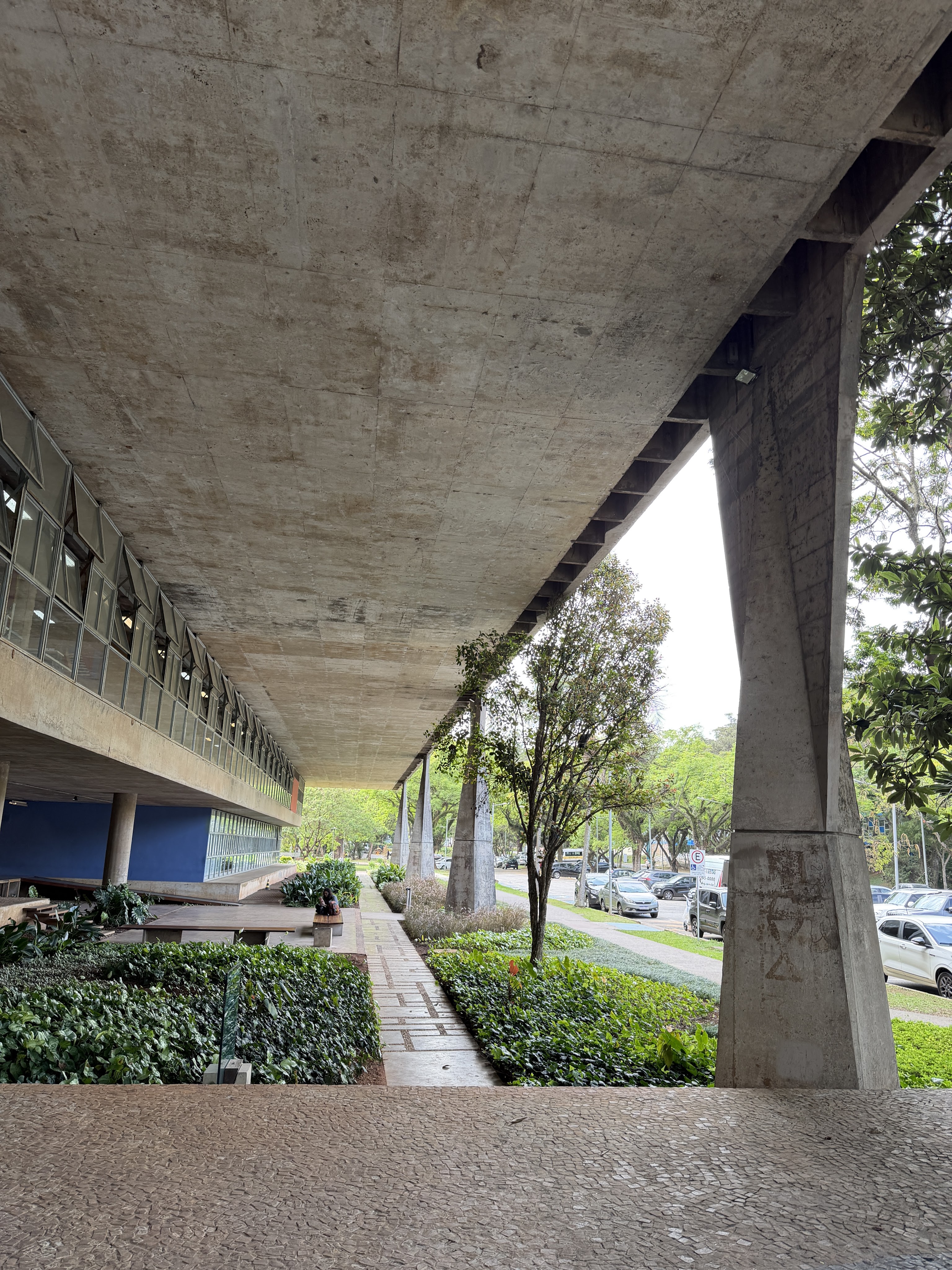
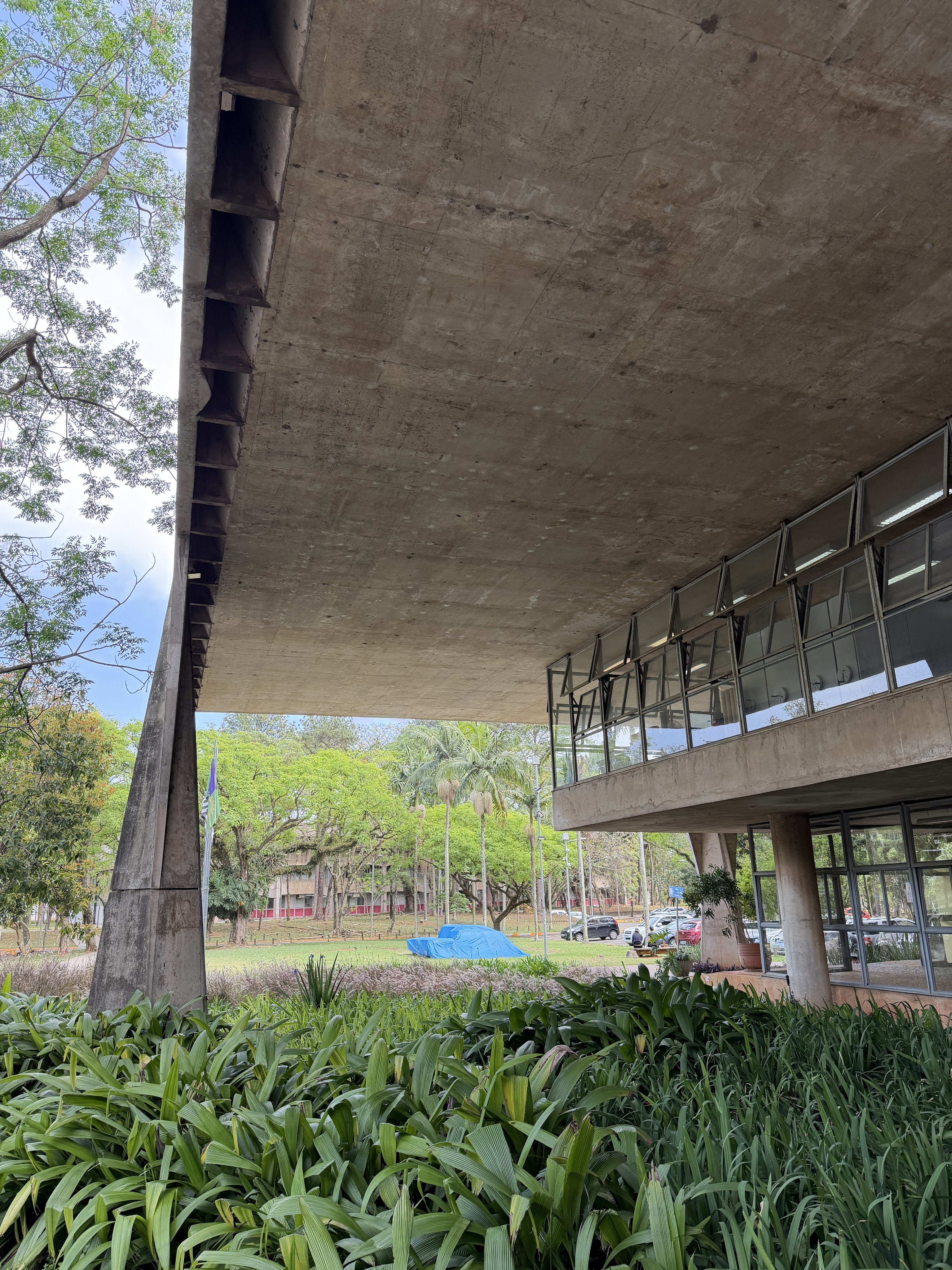
Of all the elements that make this building great, the roof is the key outstanding one. To have something made of concrete be so weightless and continuous- it defies logic. Structurally (and there is a bucket to catch the rain in one of my photos):
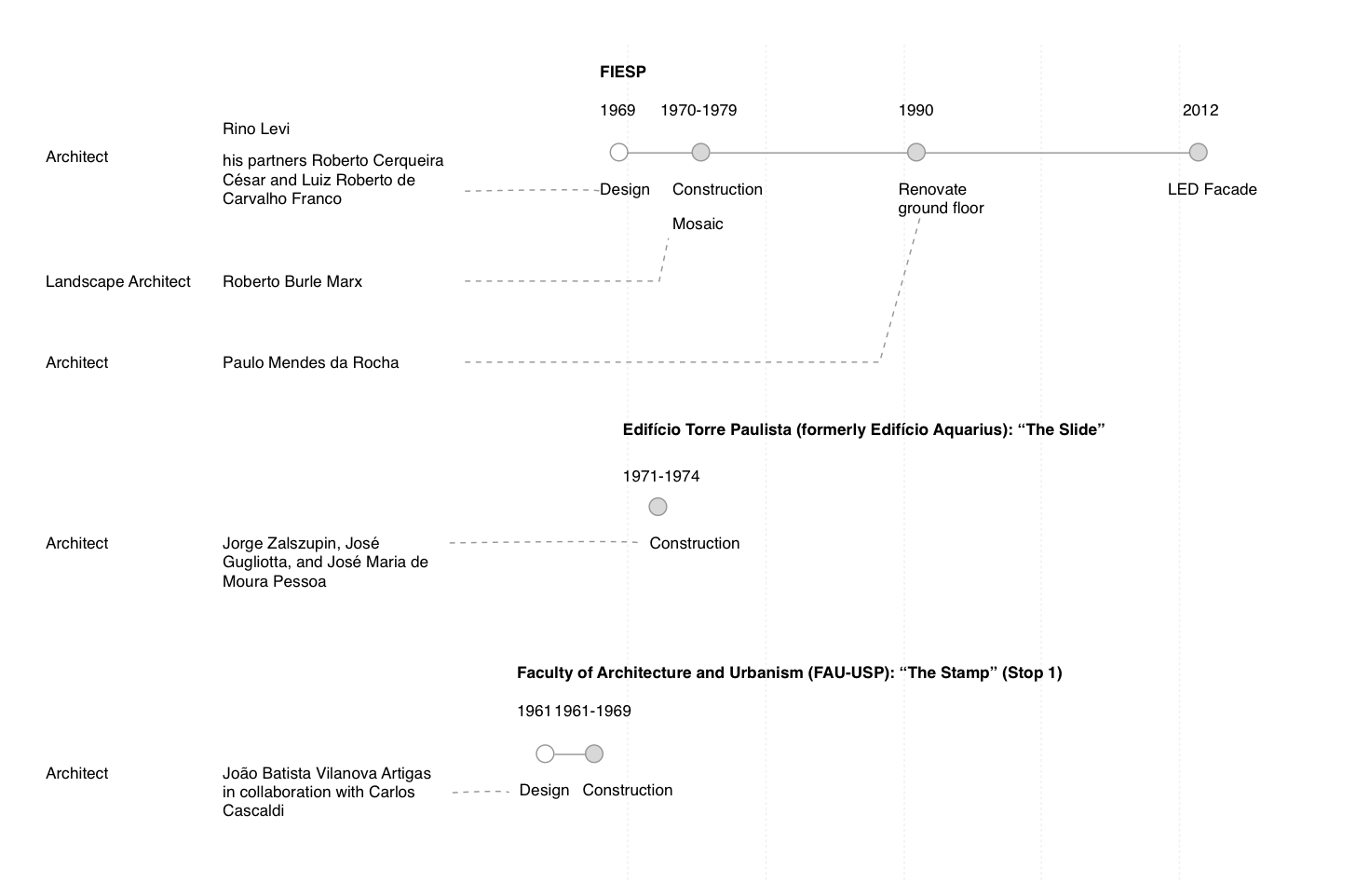
The building for the Faculty of Architecture and Urbanism at the University of São Paulo (FAU-USP), designed by João Batista Vilanova Artigas and Carlos Cascaldi (1961–1969), is a masterpiece of the Paulista School of Brazilian Brutalism. Its roof is not just a covering but the building’s primary source of light and a complex piece of engineering.
1. How the Roof Was Constructed
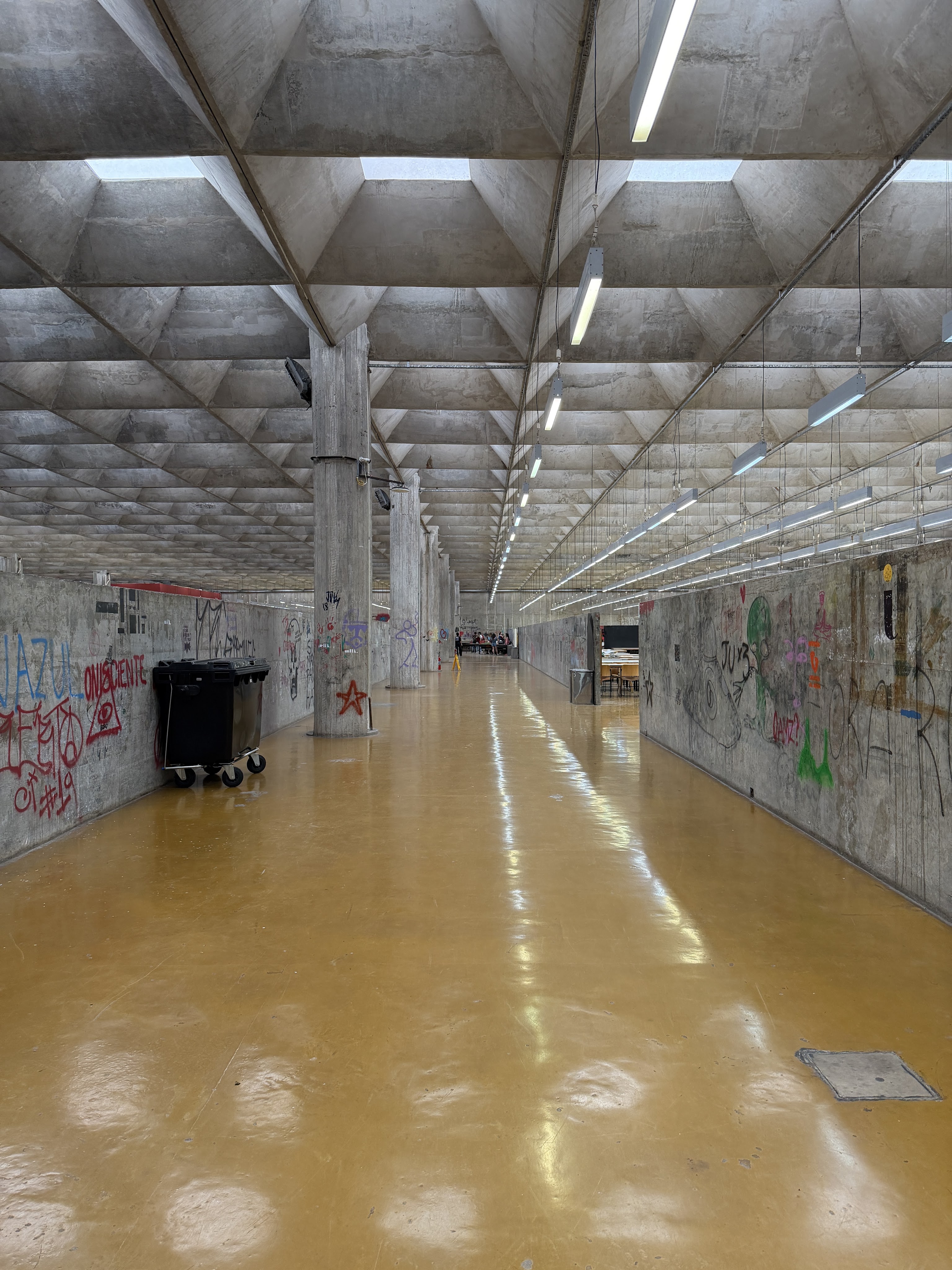
The roof is a massive, unified reinforced concrete horizontal slab measuring 110 by 66 meters. It is structured as a coffered (waffle) slab, a grid of concrete beams that provides high strength with less weight than a solid slab.
The Grid: The roof follows a strict modular grid of 2.5 x 2.5 meters.
The Skylights: Inside each square of this grid is a truncated pyramidal opening. These 960 openings are capped with translucent fiberglass domes.
The Design Intent: Artigas designed the roof to be the “fifth façade.” Because the building’s exterior walls are largely opaque concrete “boxes,” the roof is the sole provider of natural light for the studios and the central “Salão Caramelo” (the Great Hall).
2. How it Drains
Drainage for such a vast, flat concrete surface in a tropical climate like São Paulo’s is a significant challenge. The system was designed with “invisible” functionality in mind:
Internal Drainage: Instead of external gutters, which would ruin the Brutalist aesthetic, the roof uses a system of internal drains located within the concrete structure.
Concealed Downspouts: Rainwater is collected from the flat sections of the slab between the domes and directed into vertical pipes (downspouts) that are integrated into the massive concrete columns or hidden within the wall cavities.
The “Leaking” Legend: Historically, the roof has been famous for leaks. The original fiberglass domes and the joints between them and the concrete slab suffered from thermal expansion (São Paulo’s heat) and UV degradation. A major restoration between 2012 and 2015 replaced the 960 domes with modern, high-performance materials to finally resolve these chronic water issues.
3. Built from “Scratch”: The Construction Process
Building the FAU-USP was an act of “constructive resistance” during Brazil’s military dictatorship. It was built using relatively low-tech methods to create a high-concept result:
Cast-in-Place Concrete: The entire building, including the roof, was cast on-site using wooden formwork. Thousands of wooden planks were used to create the “waffle” molds for the roof.
Manual Labor: Artigas famously utilized “unskilled” labor, believing that the “rough” finish of the concrete (showing the grain of the wood) documented the reality of the Brazilian working class.
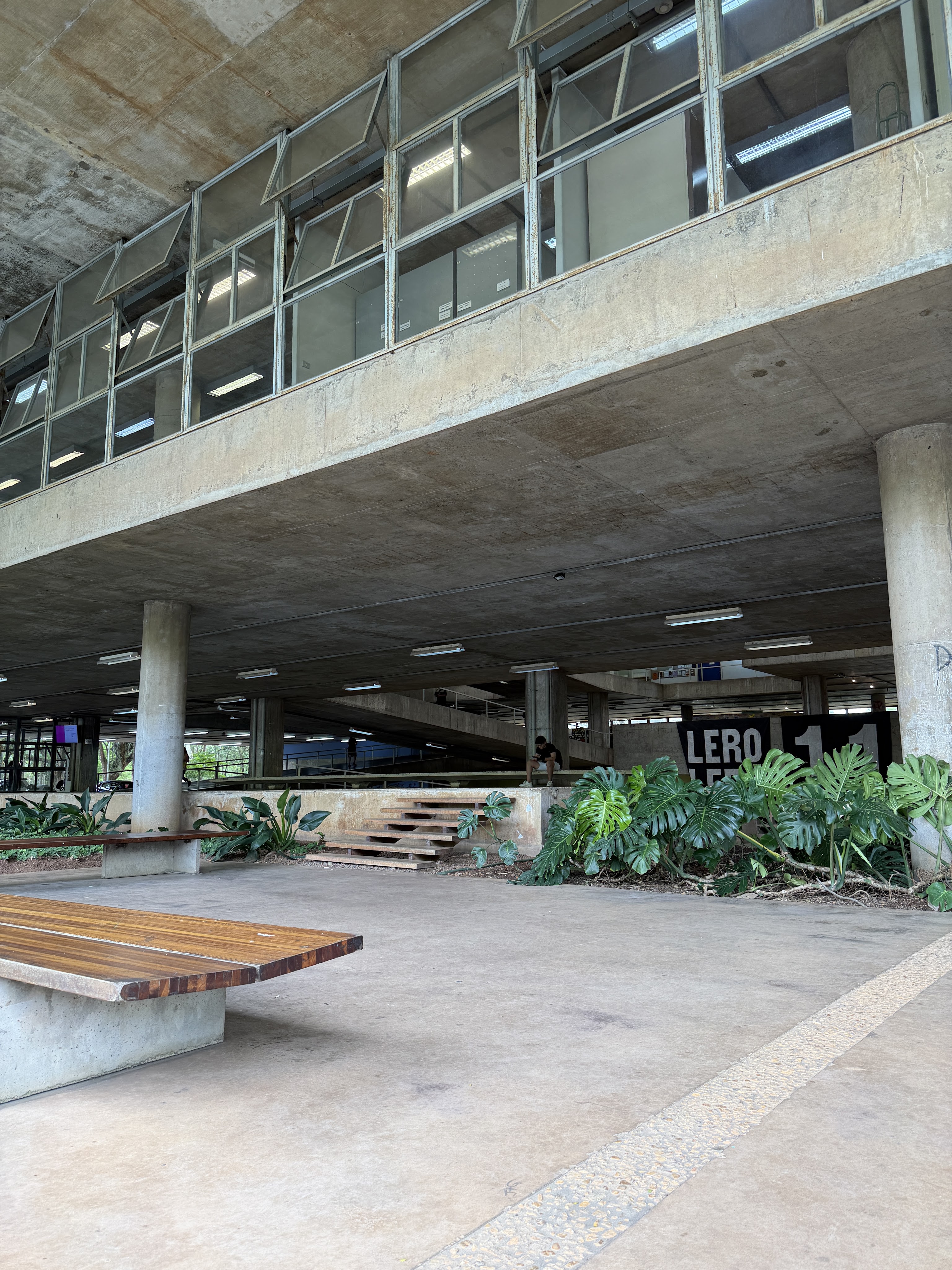
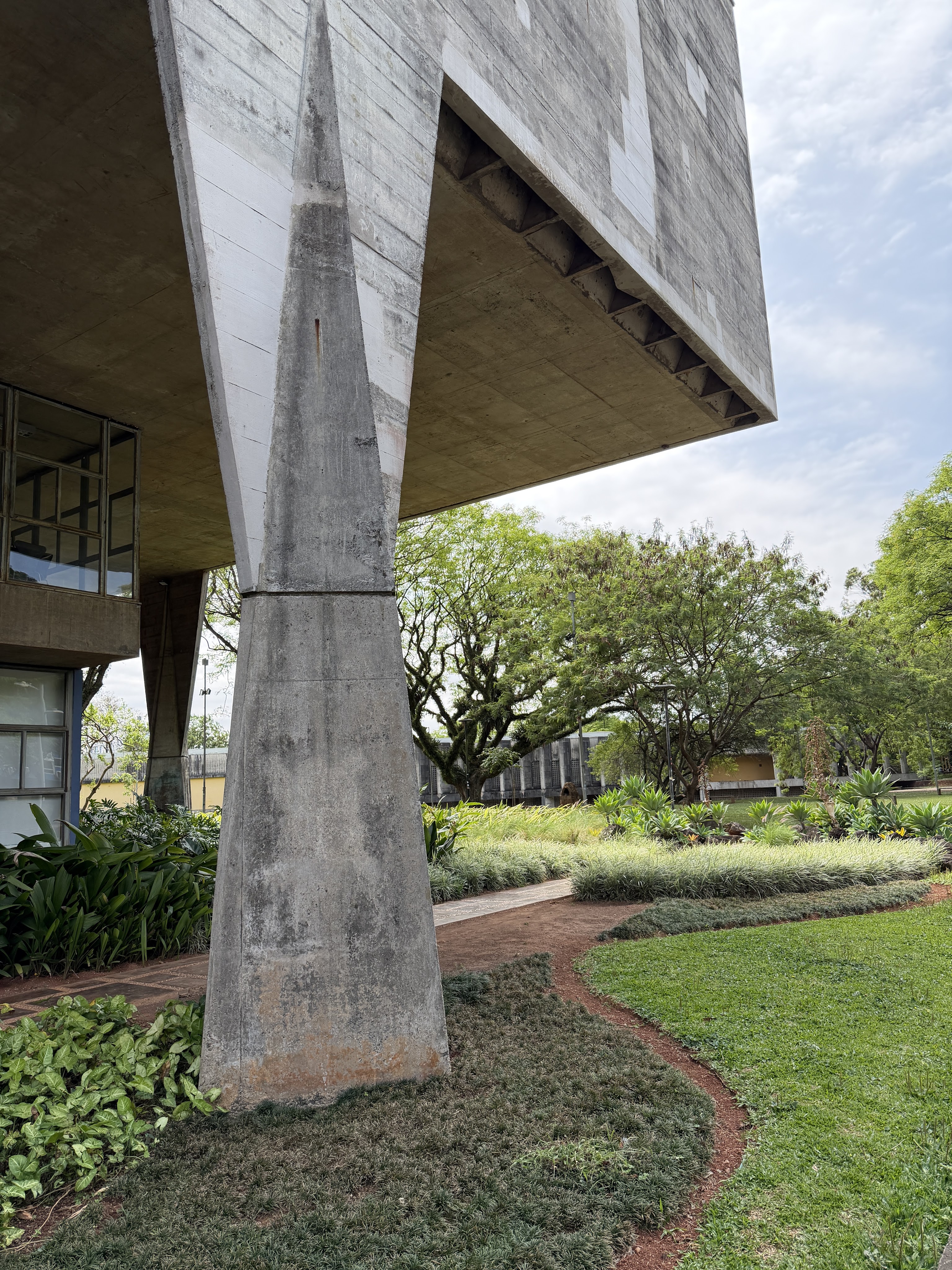
Sequential Pouring: The construction began with the foundation and the sculptural, double-tapered columns (which look like they barely touch the ground). Once the columns and the main perimeter “box” were set, the massive roof slab was poured in sections.
The Central Void: Because the roof is supported by the external columns and a few internal ones, the center of the building remained open during construction to allow for the assembly of the ramp system, which was built after the main shell was stabilized.
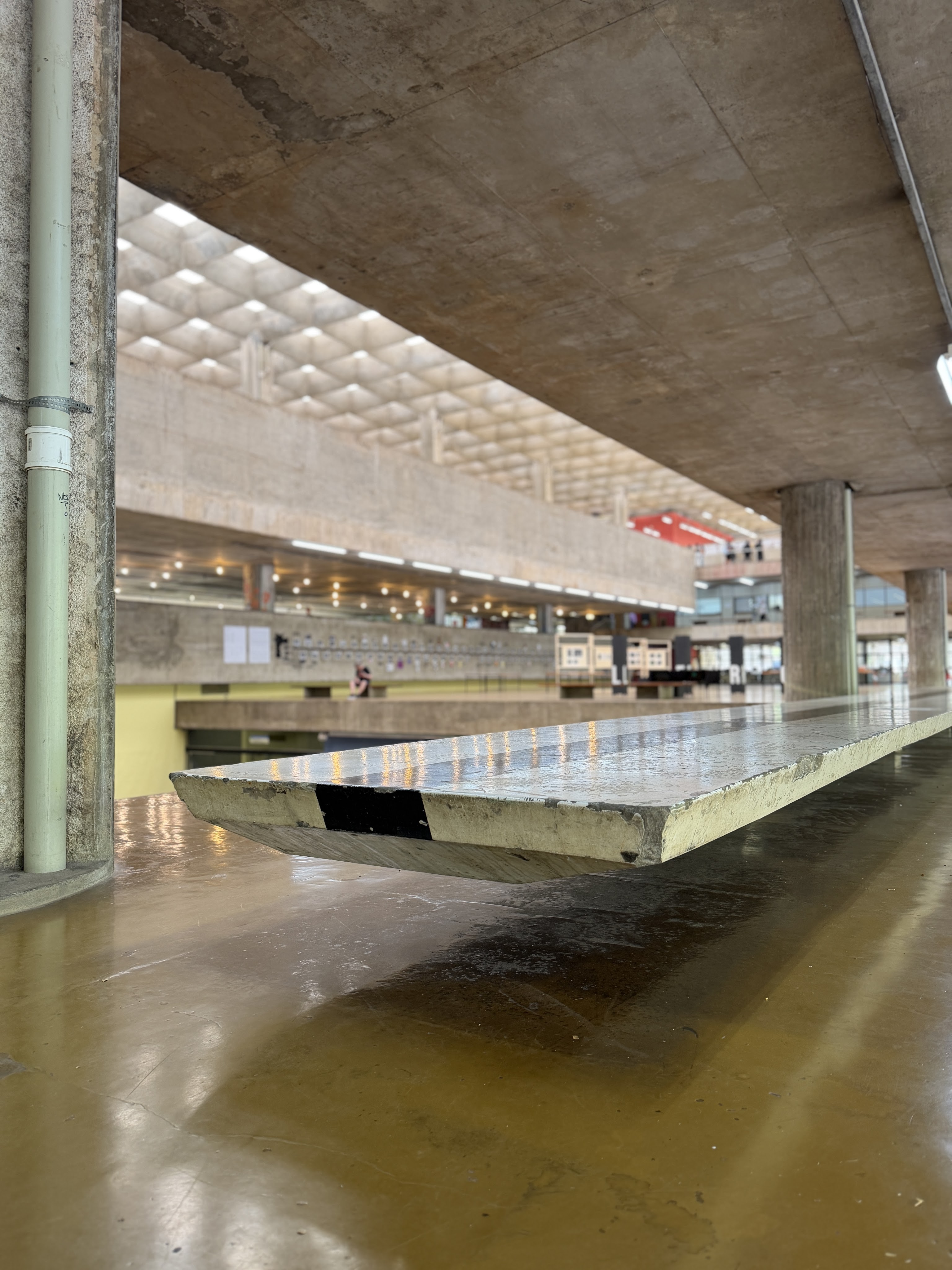
The floating planes. From the doorless entry into this massive space and traversing the ramps to the top floor to see the continuous source of light floating in all the planes. Vertical, horizontal- everything is defying. As we had a firm and busy itinerary, we didn’t get to stay as long as I would have liked- perhaps I never full get the time that I want anywhere and so much be grateful to have had it at all.
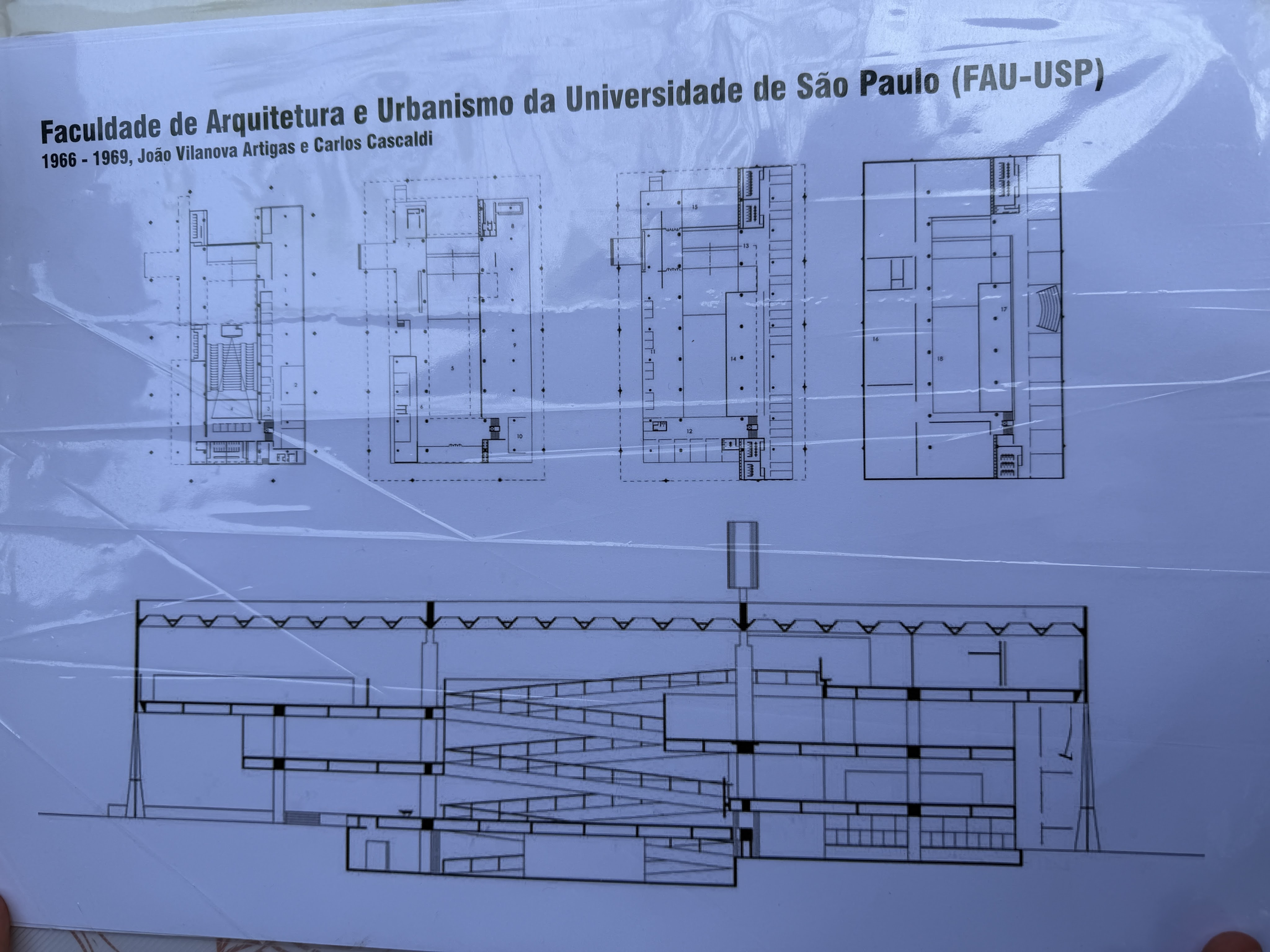
The plans. A happy moment for me when at lunch later we got to take a look.
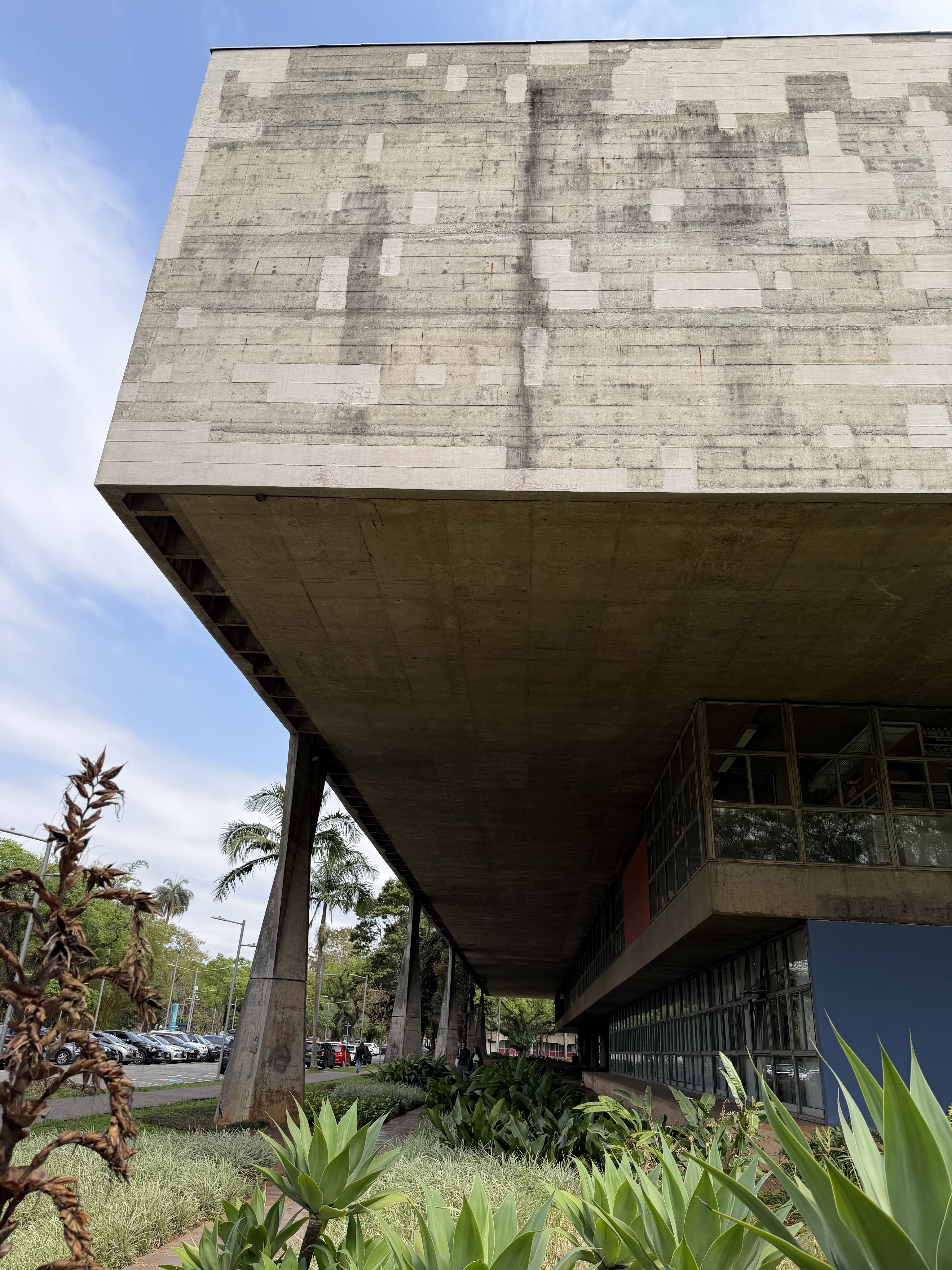
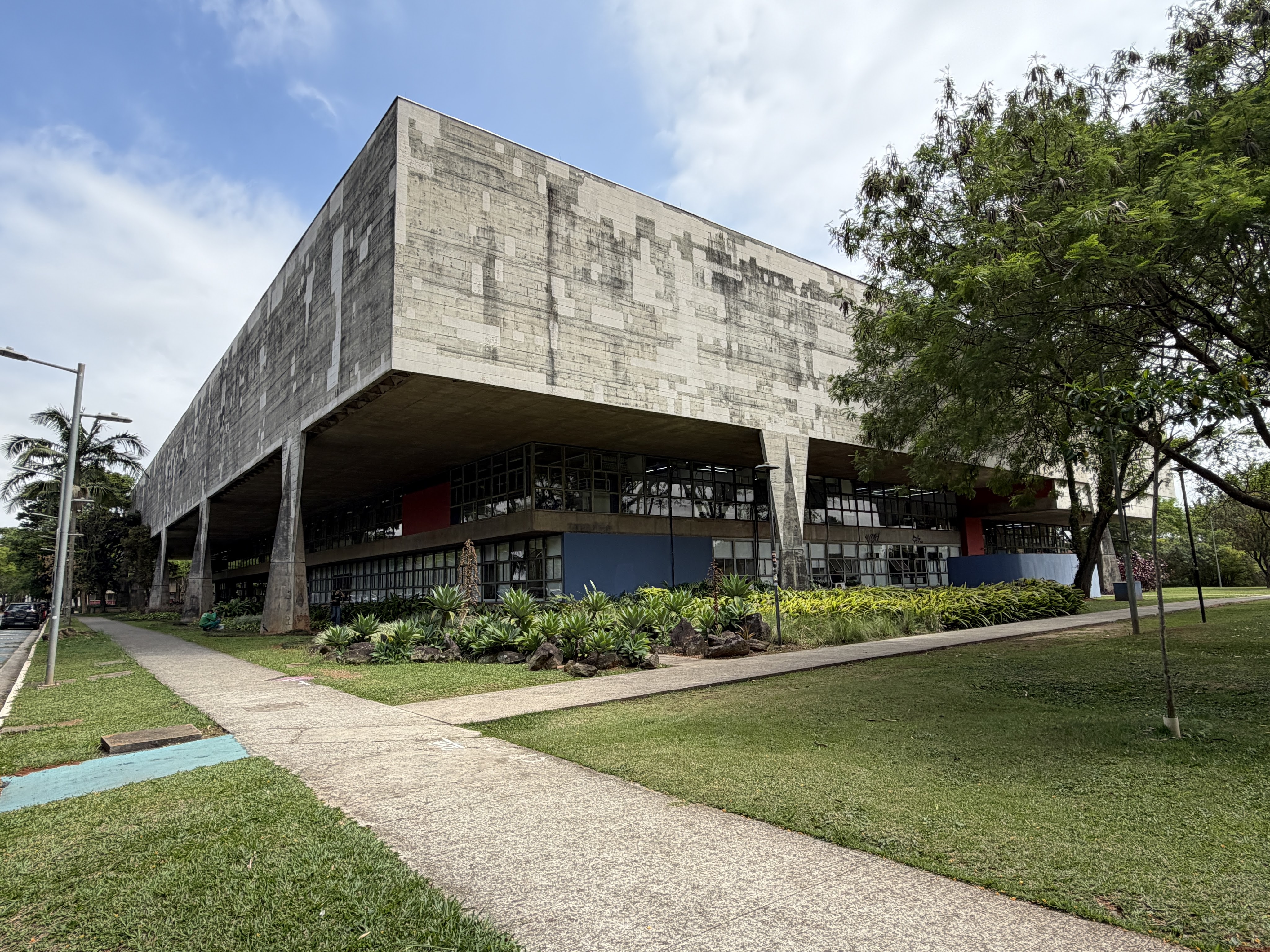
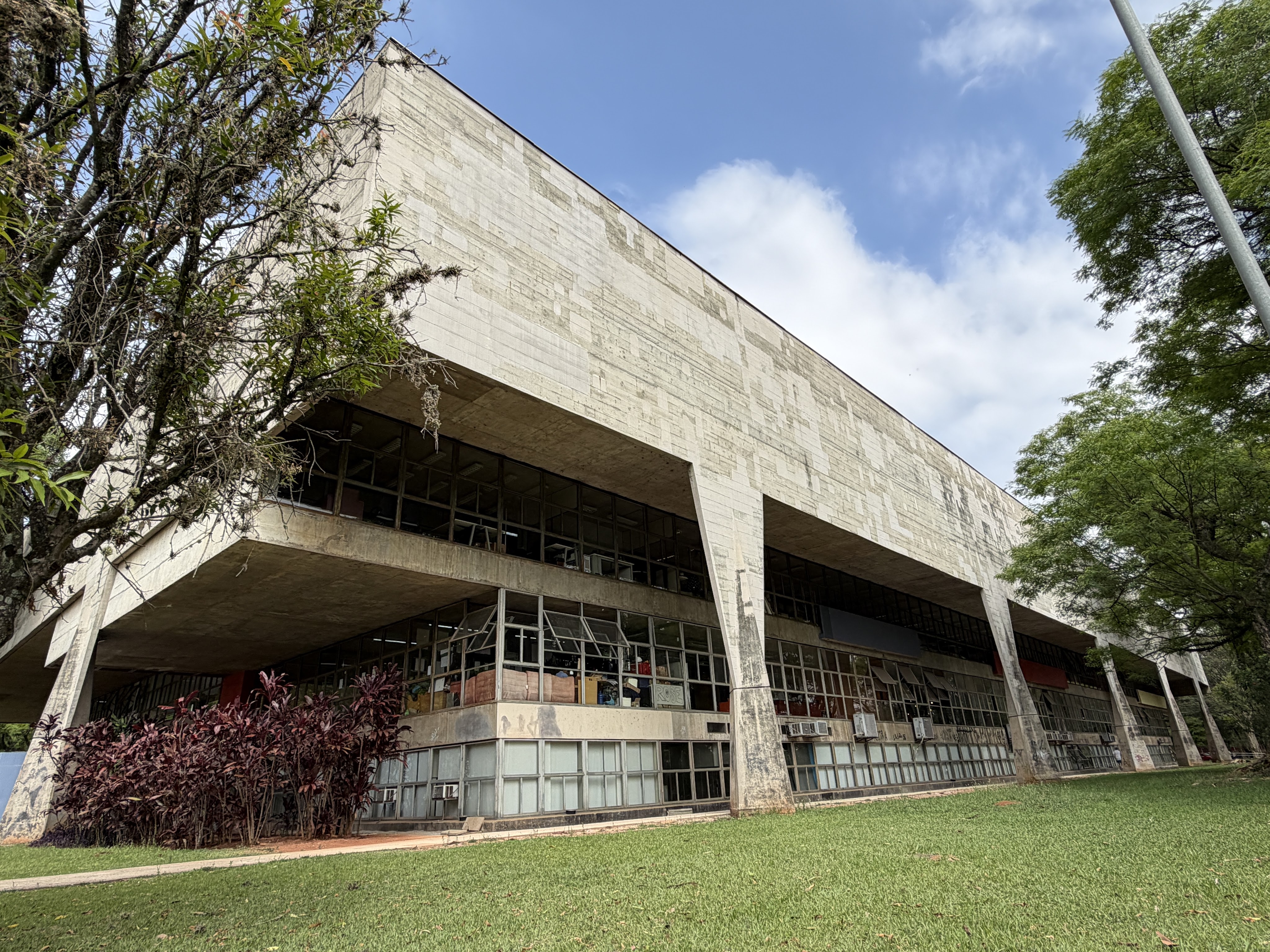
Even the outer structure was impressive- the column shapes like tree trunks, an essential part in the construction order to raise the building and particularly the roof. Not just on the inside, but even on the outside, Artigas carried out this principle about providing space and raising massive concrete forms.
An example of how what we see is based on what we believe:
“Honesty of materials” was paramount- reinforced and exposed concrete was treated as a noble material by the Paulista school. They believed believing that “truth in materials” reflected a “truth in society.”
During the coup, the government applied their own beliefs saw the “strength” and “honesty” of raw concrete as a perfect fit for their image of a disciplined, powerful nation.
An architecture student myself, I was overjoyed to be back in a studio learning environment. I recall just now, how coincidentally, that my own education on architecture was in Meyerson Hall which is often mistaken as brutalism due to its raw exposed concrete (completed in 1967 right at the same time as this building) and also topped by skylights.
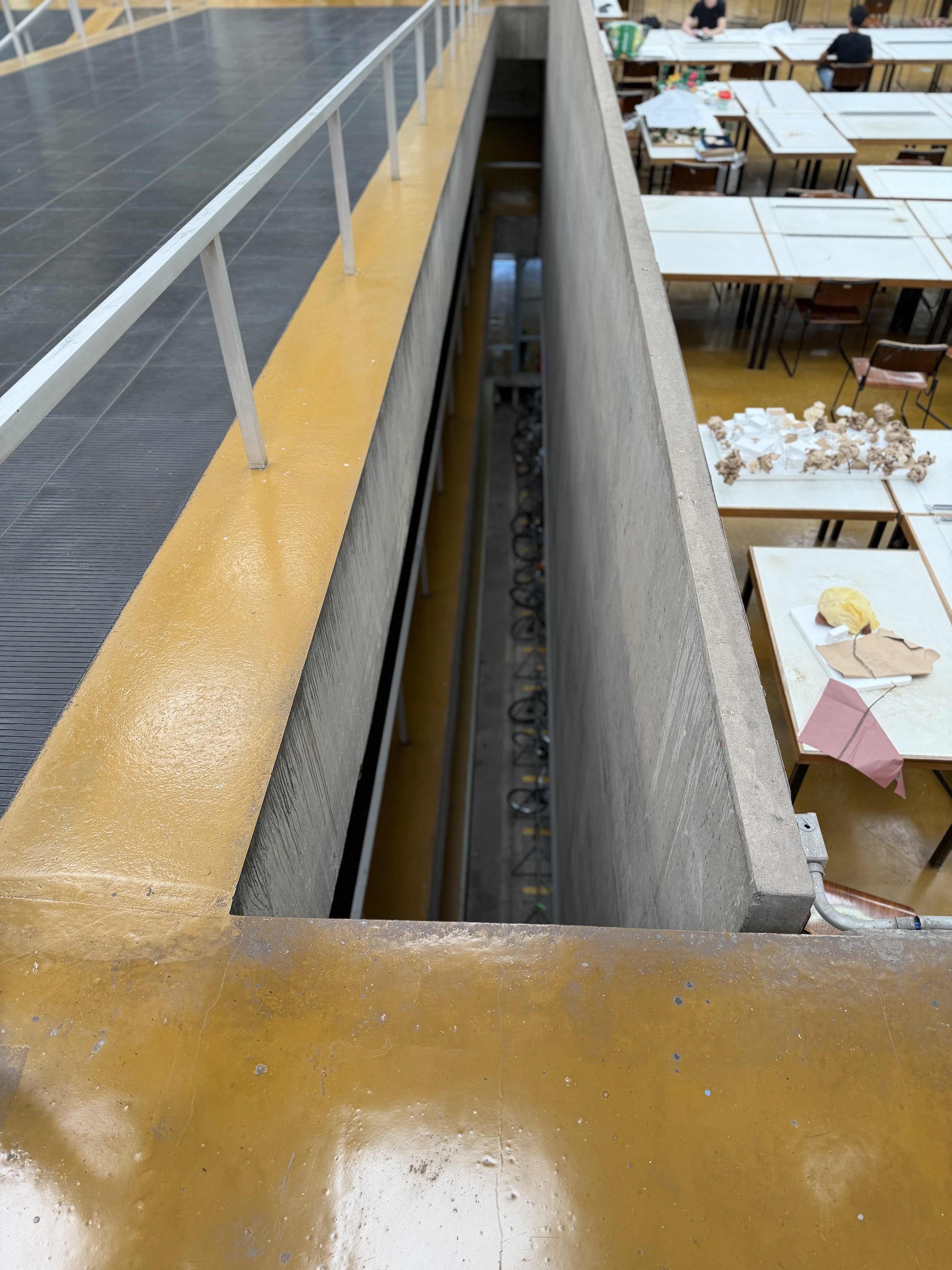
These studios are a place to try your ideas, to see what space brings as it welcomes it all. There is probably no harder discipline than architecture in the arts.
“I saw it as the spatialization of democracy, in dignified spaces, without front doors – a temple where all activities are valid,” he wrote.
Source: Puntoni, Alvaro (ed). et al, Vilanova Artigas, Instituto Lina Bo e P M Bardi, Fundacao Vilanova Artigas, São Paulo 1997, p 101
P.S. the LLM was getting a bit flowery in its responses (especially when I asked about the symbolism of the sun to the Paulista School) now so my intuition is telling me to find the sources, like all the time. The sources really are important and but also time consuming to read- and that is what LLMs are supposed to do, save time but are they really if we cannot trust them to be true? The exercise for the 8 posts will be an exercise in efficiency- putting LLMs to the test of whether they help or not. What I’ve noticed is that using these LLMs, I am eager to look for fact rather than spending time finding the expression for my own perspective. There is so much to learn but what of it if not applied to something creative or solving new problem. Let us forget not to make.
The 1964 military coup didn’t just change the government; it shattered the professional and personal lives of the “modernist generation.” Leftist architects, many of whom were members of the Brazilian Communist Party (PCB), found themselves in a paradoxical position: they were viewed as “subversives” by the state, yet the state still needed their expertise to build the country’s infrastructure.
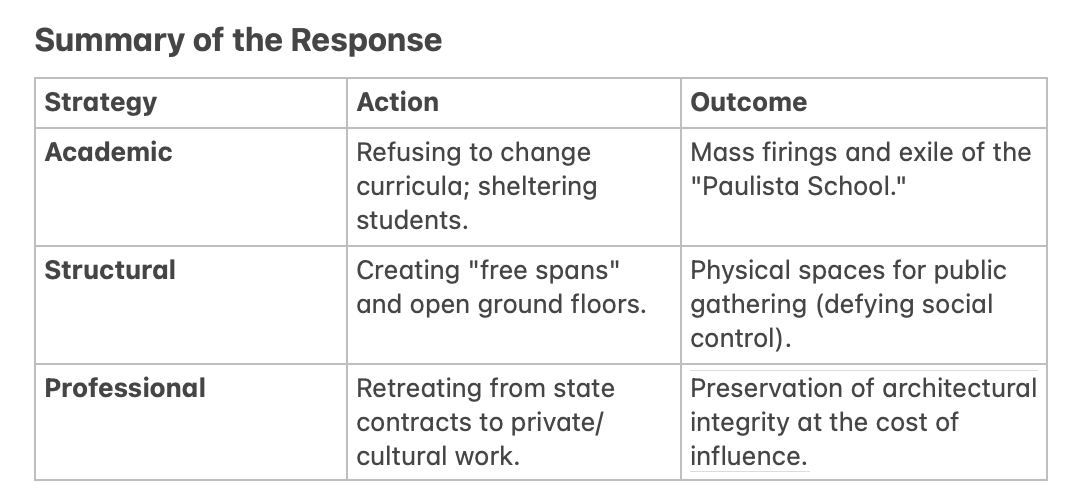
Their response can be categorized into three distinct phases: Resistance, Internal Exile, and Subversive Design.
1. Academic and Institutional Resistance
The most immediate response occurred in the universities, particularly at the University of São Paulo (FAU-USP).
The Faculty of Architecture as a Fortress: Architects like Vilanova Artigas and Paulo Mendes da Rocha turned the architecture school into a hub for political debate. They believed that teaching architecture was a form of political activism.
The Purge (AI-5): In 1968, the regime issued Institutional Act No. 5 (AI-5), which stripped many leftist intellectuals of their civil rights. Artigas, Mendes da Rocha, and others were forcibly removed from their teaching positions. Artigas was even briefly imprisoned and then forced into exile in Uruguay.
2. Subverting the “Concrete” Language
Denied the ability to participate in state planning, leftist architects used their building materials—specifically reinforced concrete—to make silent political statements.
Brutalism as “Social Truth”: While the military liked concrete for its strength, leftist architects used it to represent “honesty.” They refused to hide structural elements or use decorative finishes, believing that “truth in materials” reflected a “truth in society.”
The “Urban Square” Concept: In projects like the MASP (Museum of Art of São Paulo) by Lina Bo Bardi, the response to the coup was literal space-clearing. By suspending the massive building on four red pillars, Bo Bardi created a massive public plaza underneath. In a time of restricted assembly, this “void” was a gift of free, democratic space to the city’s people.
3. Shift to Social and Cultural Projects
As the regime focused on massive “Pharaonic” projects (like the Trans-Amazonian Highway), leftist architects pivoted toward the “micro-scale” or community-focused works.
Lina Bo Bardi’s SESC Pompéia: Though finished later, this project started as a response to industrial decay. Instead of a sleek, elitist club, she designed a “culture and leisure factory” for the working class.
Alternative Practices: Many architects moved into set design, graphic arts, or small-scale residential work to avoid collaborating with the military’s large-scale urban interventions, which they saw as tools of social segregation and surveillance.
The construction of the FAU-USP (School of Architecture and Urbanism at the University of São Paulo) is perhaps the most dramatic architectural “biography” of the 1964 coup. Because its construction spanned the transition from democracy to dictatorship, the building itself transformed from a manifesto of freedom into a site of political trauma.
1. The Design Intent (1961–1964): The “School of Freedom” When João Batista Vilanova Artigas and Carlos Cascaldi designed the building in 1961, they were designing for a socialist-leaning, democratic future.
The “No-Door” Policy: Artigas famously designed the building without an entrance door. The ground floor (the piazza) was intended to be a continuous extension of the sidewalk. This was a literal architectural translation of “public space” and “free access to knowledge.”
The Great Central Void: The building features a massive internal atrium (the Caramelo) covered by a grid of skylights. This was designed to force students and professors from different years and disciplines to see one another, fostering a “transparent” and non-hierarchical academic community.
2. The Coup and the Paradox of Construction (1964–1968) When the tanks rolled into the streets in 1964, the FAU-USP was an active construction site. This created a surreal paradox.
The Architects as “Subversives”: Artigas and his peers were active members of the Communist Party. After the coup, they were immediately targeted. Artigas had to flee to Uruguay to avoid arrest, yet the military government—which prized national development and “Big Engineering”—continued to fund and build his design.
Concrete as a Common Ground: The military regime respected the “strength” and “modernity” of the reinforced concrete. They allowed the building to proceed because it looked like the future of a powerful Brazil, even though the architects intended it to be the future of a liberated Brazil.
3. The 1969 “Enclosure” and the AI-5 Crisis
As the building reached completion in 1969, the political environment turned from cold to frozen. The issuance of Institutio nal Act No. 5 (AI-5) in late 1968 changed everything for the school.
The Purge of the Faculty: Just as the building was being inaugurated, the regime “retired” Artigas and Paulo Mendes da Rocha by decree. They were banned from the very building they had just finished creating.
Surveillance of the “Free Space”: The open, doorless design that Artigas intended for democracy became a liability under the dictatorship. The “Great Void” in the center, designed for debate, became a place where the military police could easily monitor student assemblies from the ramps above.
The Modification of the Spirit: While the physical building remained “open,” the atmosphere became one of “Internal Exile.” The ramps, designed for fluid movement and “democratic encounters,” were now paced by students who were under constant threat of disappearance or arrest.
The Final Irony Artigas returned to the FAU-USP in 1979 during the Anistia (Amnesty) period. Upon walking into the building he designed but was exiled from, he noted that the architecture had “survived” the regime. The building remained a symbol of resistance precisely because its open spaces were too large and too bold for the military to successfully “close” without destroying the structure itself.

 ofallthespaces