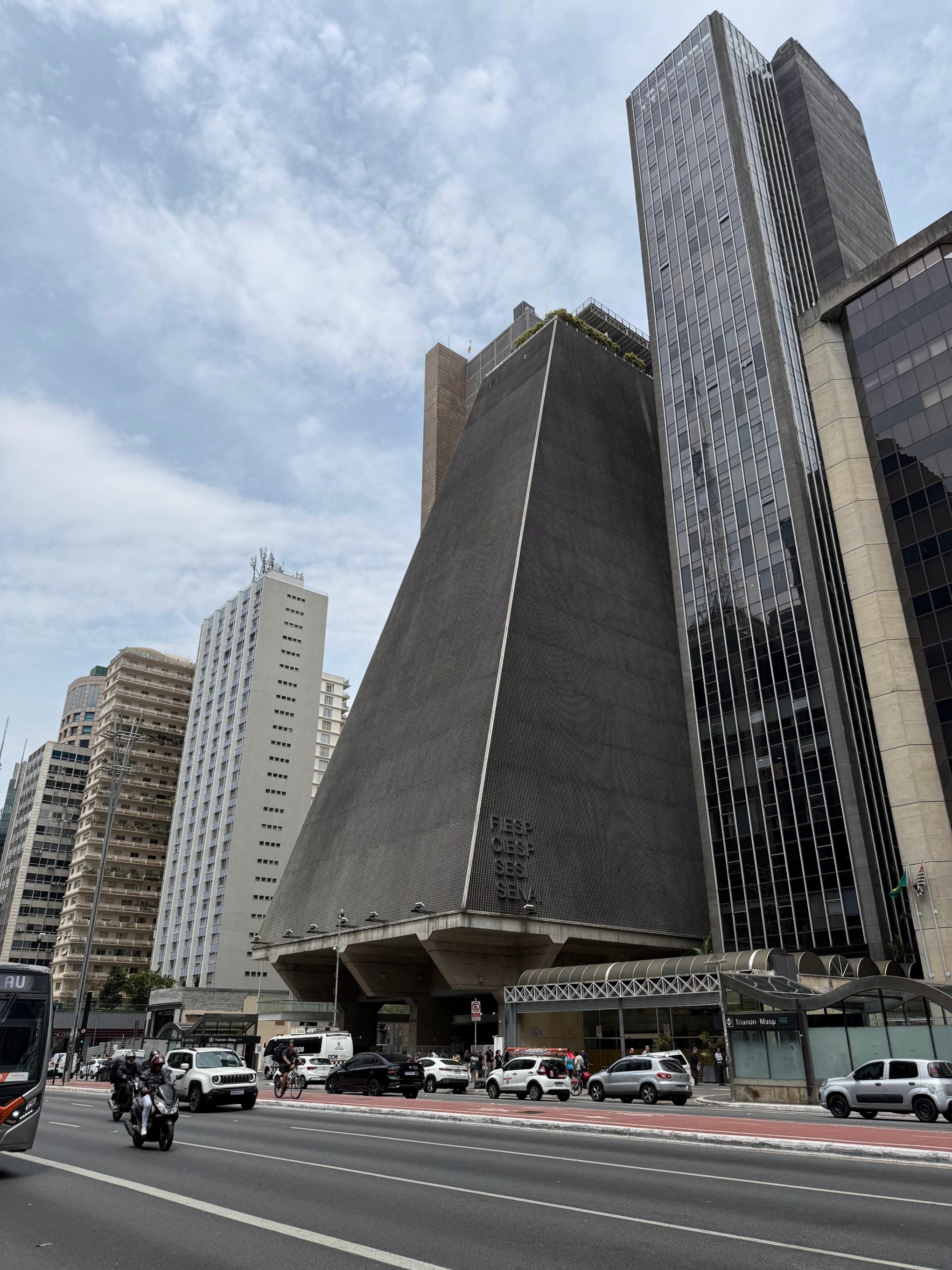
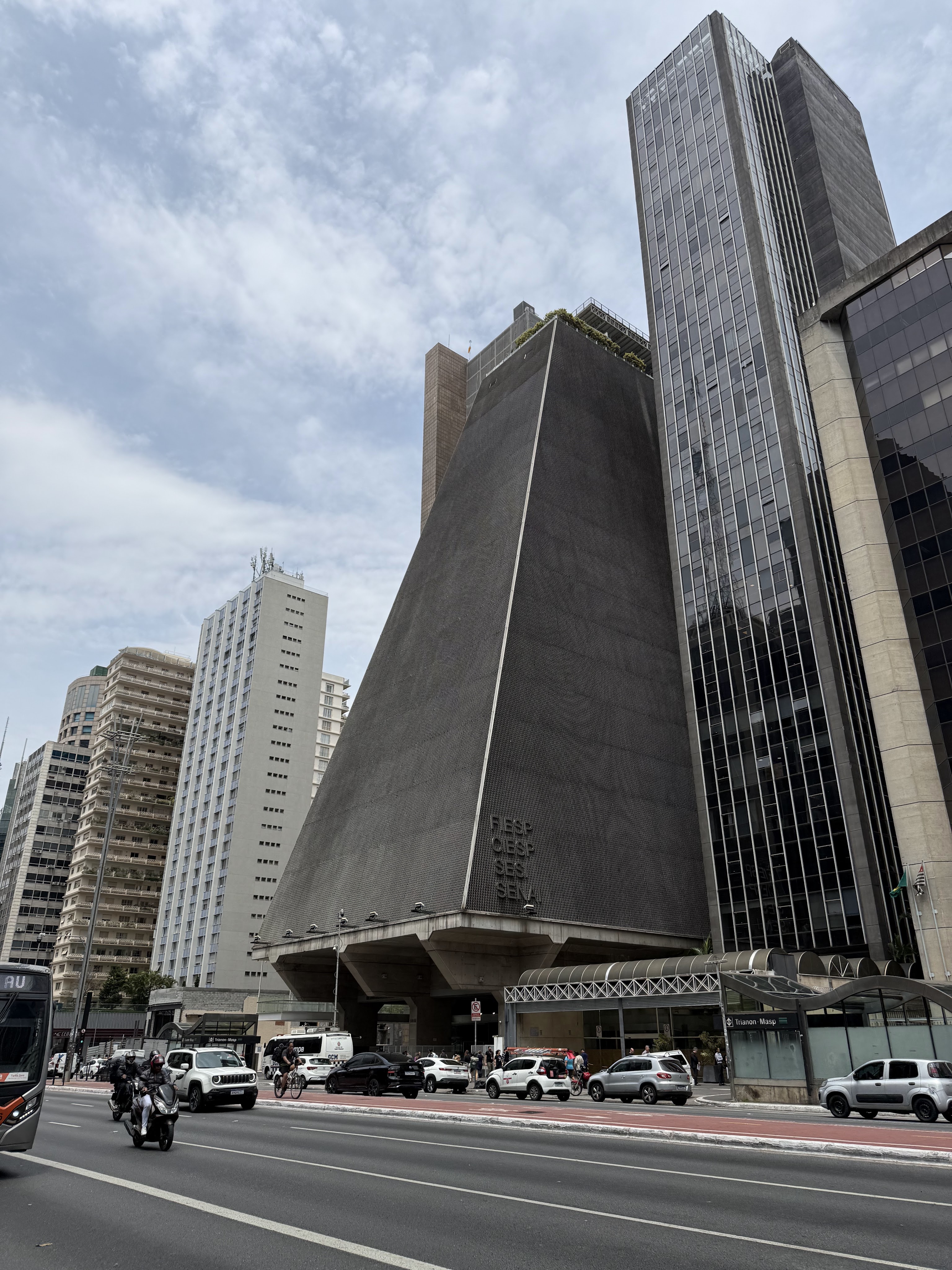
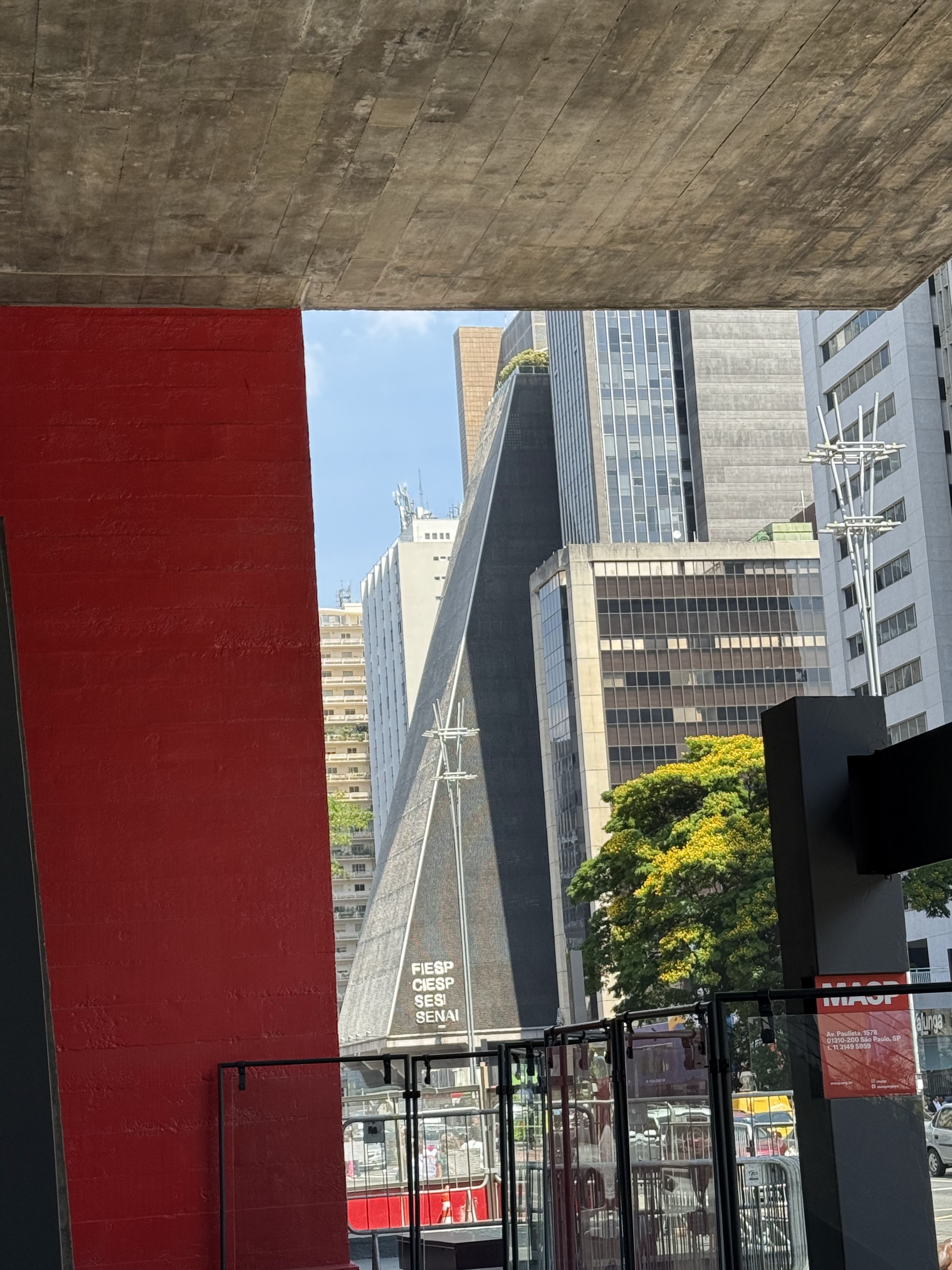
This is the one that started it all. Like- what the living heck is this thing? If George Lucas wasn’t from California I would say that Star Wars Lambda-Class Shuttle and other similar star ships would have been inspired by this building. The technical feat of raising massive concrete blocks into the air does in fact reflect a futurism not unlike that inspired by Star Wars.
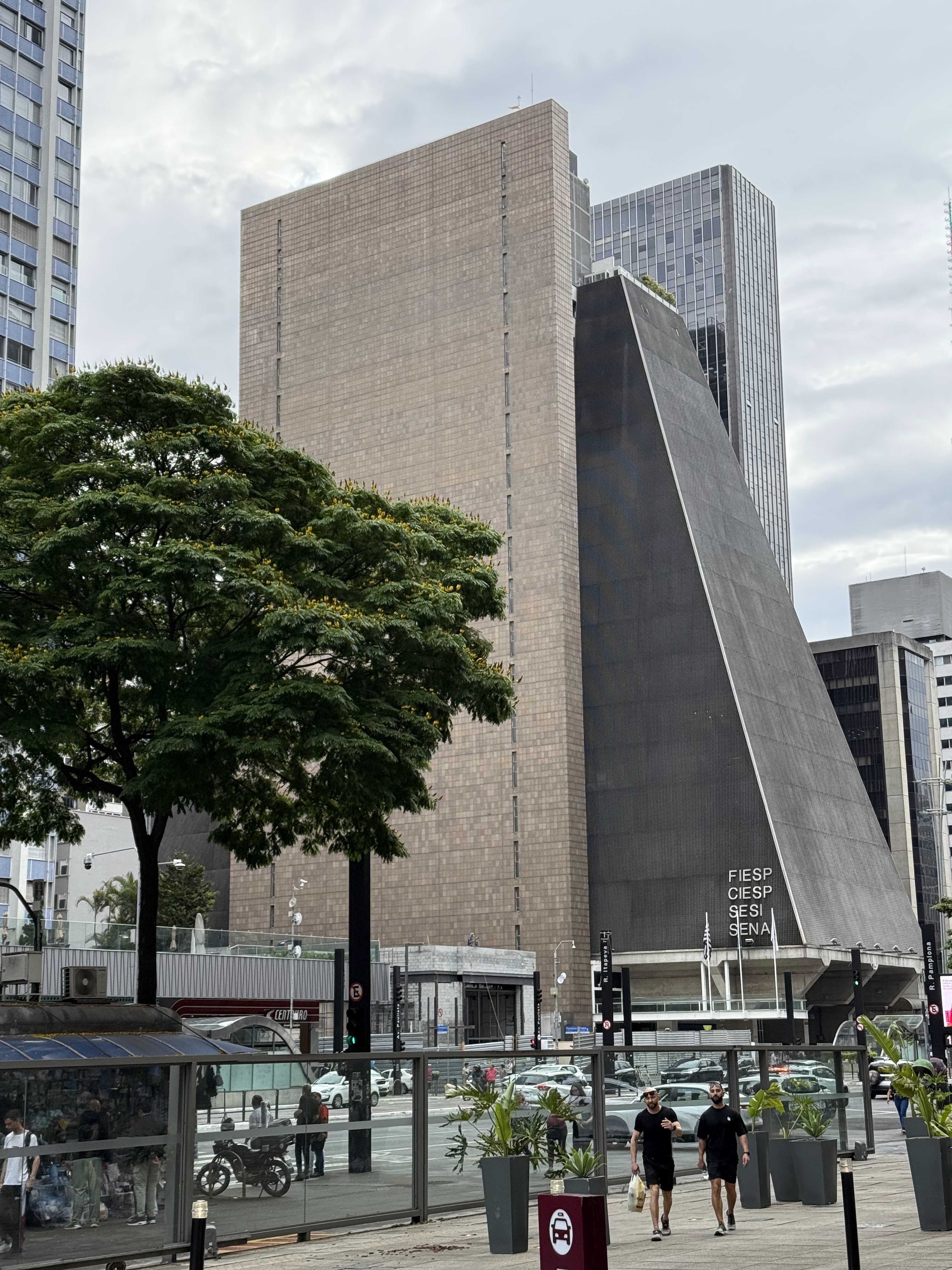
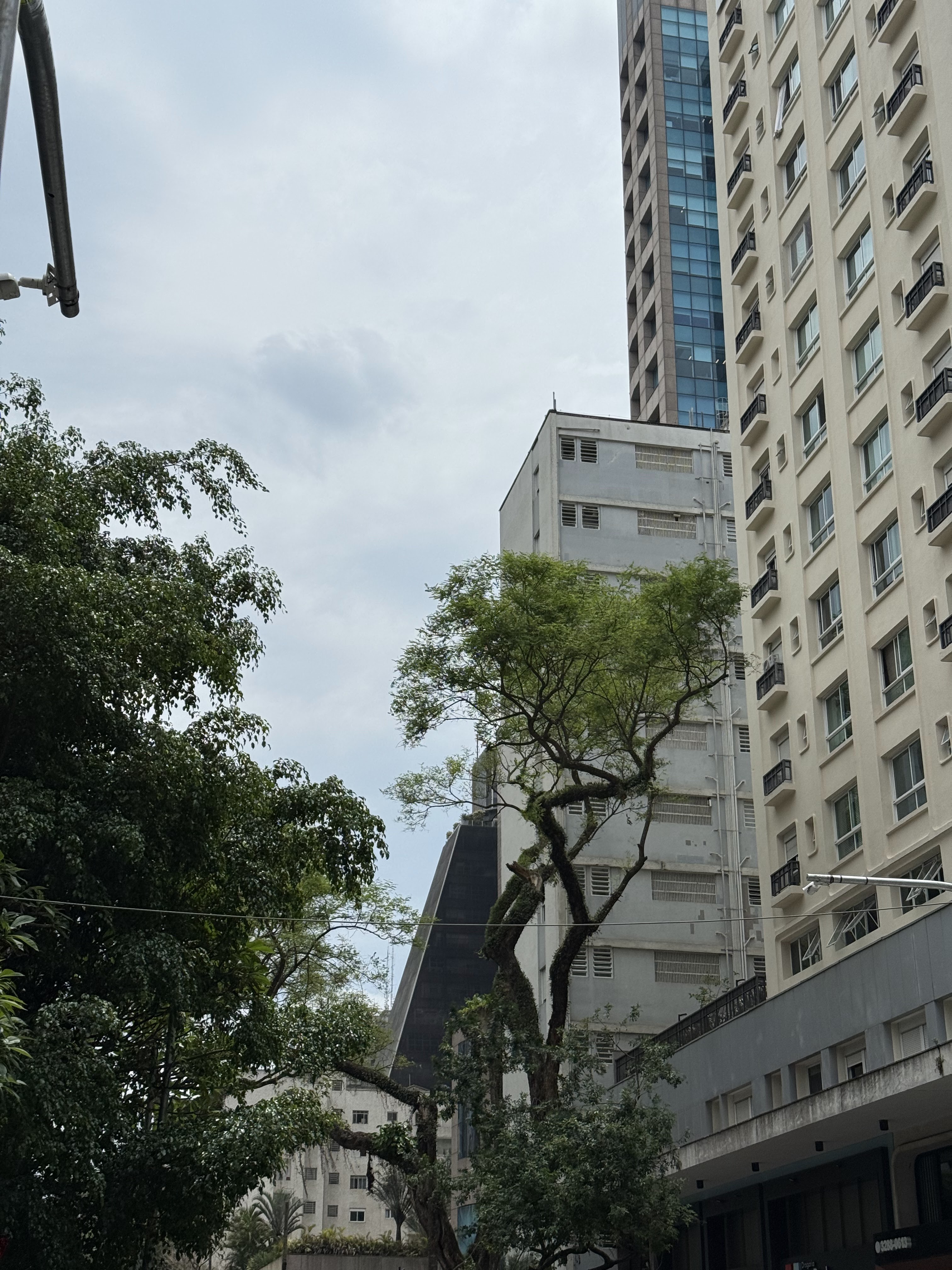
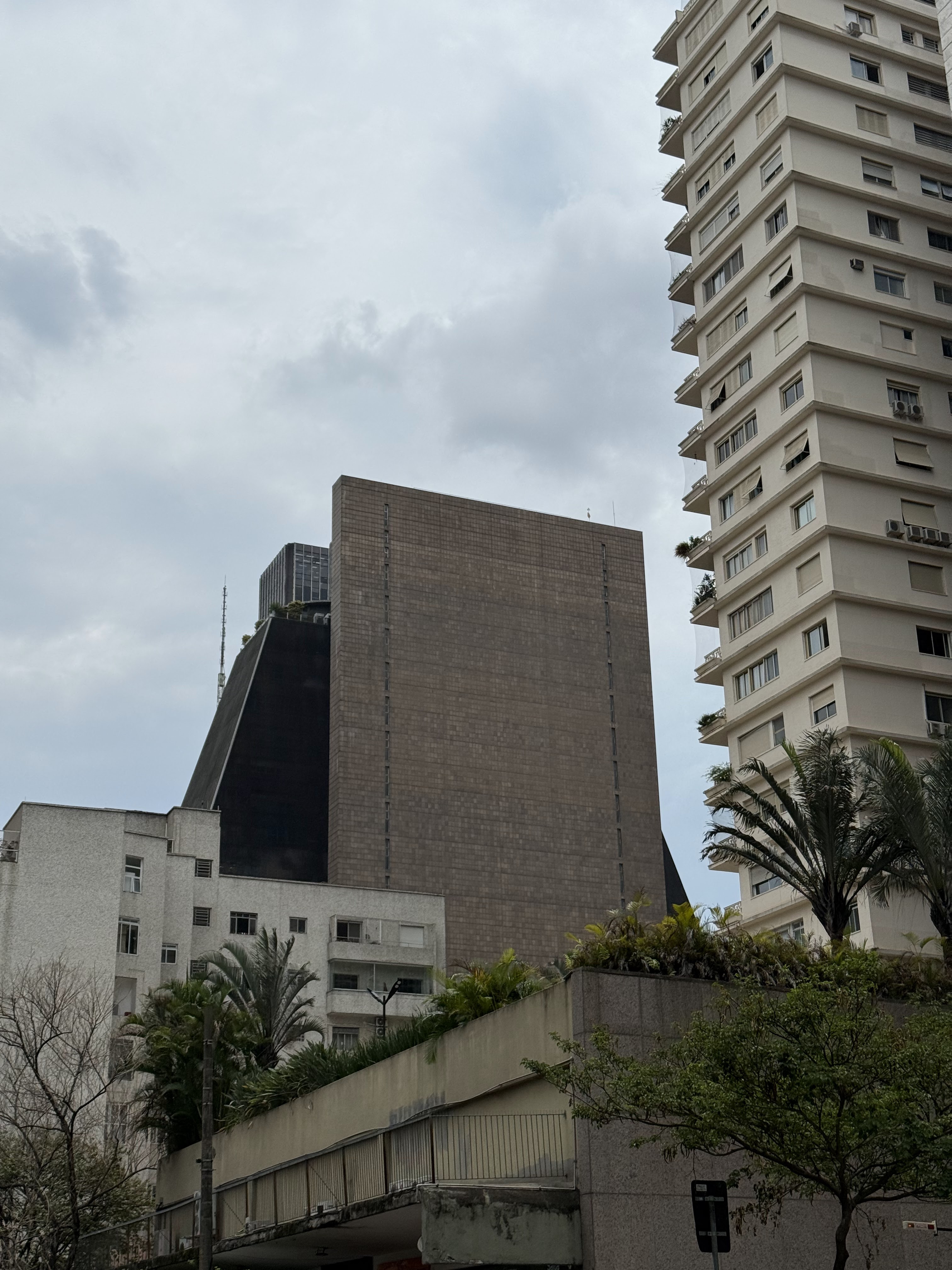
The most fascinating part about this building is the elevation- this photo was the best I could do to capture the fact that this building is isosceles trapezoidal in shape. The building is difficult to capture and one that would be interesting to return to at night for a better photographic opportunity- Paulista Avenue is incredibly busy with cars and pedestrians alike- and also the LED facade from 2012 that was installed.
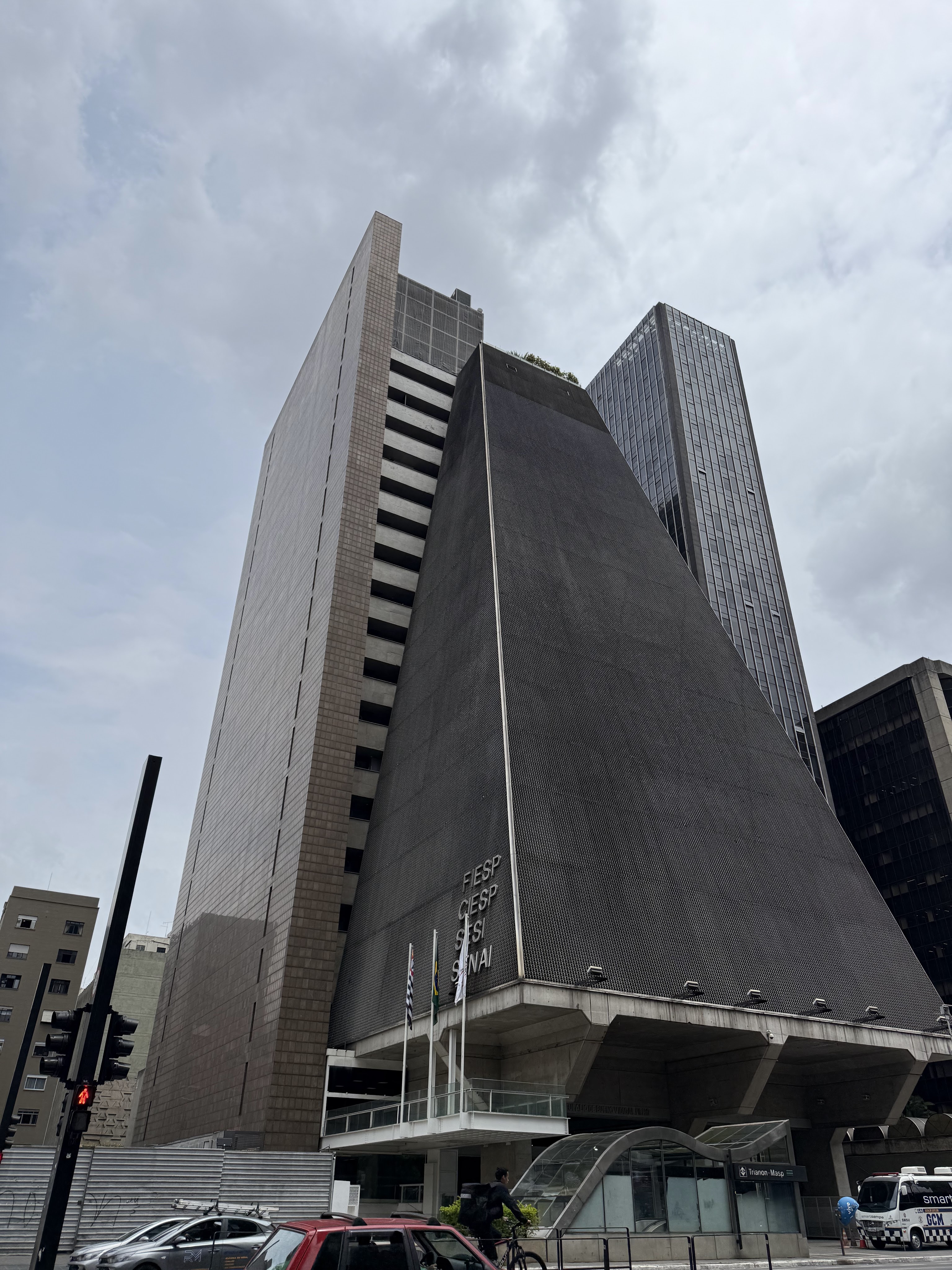
The facts from Gemini 3.1 Pro (Mar 3, 2026):
The FIESP Building (officially the Edifício Luís Eulálio de Bueno Vidigal Filho) is one of the most eccentric landmarks on Avenida Paulista. Its history is a perfect case study of how the avenue transitioned from a street of “coffee baron” mansions to a high-density financial and cultural hub.
The building was designed by the firm Rino Levi Arquitetos Associados. Interestingly, Rino Levi himself—a pioneer of Brazilian modernism—passed away in 1965, several years before the project truly took shape. The design was spearheaded by his partners Roberto Cerqueira César and Luiz Roberto de Carvalho Franco, who won a 1969 competition to create a “landmark” for the Federation of Industries of the State of São Paulo (FIESP).
- Construction: 1970–1979
- Style: Brutalist/Modernist
- Key Feature: Its iconic pyramidal shape. This wasn’t just for flair; the tapering floors were designed to allow more sunlight to reach the lower levels and the street below, adhering to the “sunlight codes” of the era.
Before the pyramid rose, the site was occupied by the Nagib Salem mansion, one of the grand European-style villas that defined the avenue in the early 20th century. Its demolition in the late 1960s signaled the final death knell for the avenue’s residential past, paving the way for the “verticalization” that turned Paulista into the “Wall Street of Brazil.” The building represents the “second wave” of Paulista Avenue’s development.
Indeed walking around this neighborhood there were a lot of well heeled business people heading to lunch. The cafes were all about lunch specials driven towards the 9-5 occupants of this area. Side note: a good walk from here is through Trianon Park over to Rua Oscar Freire with a stop at Santo Grão for an amazing coffee selection and bite to eat. There’s quite the elevation change on this walk and its a wonderful chance like on all walks to experience the transition between neighborhoods.
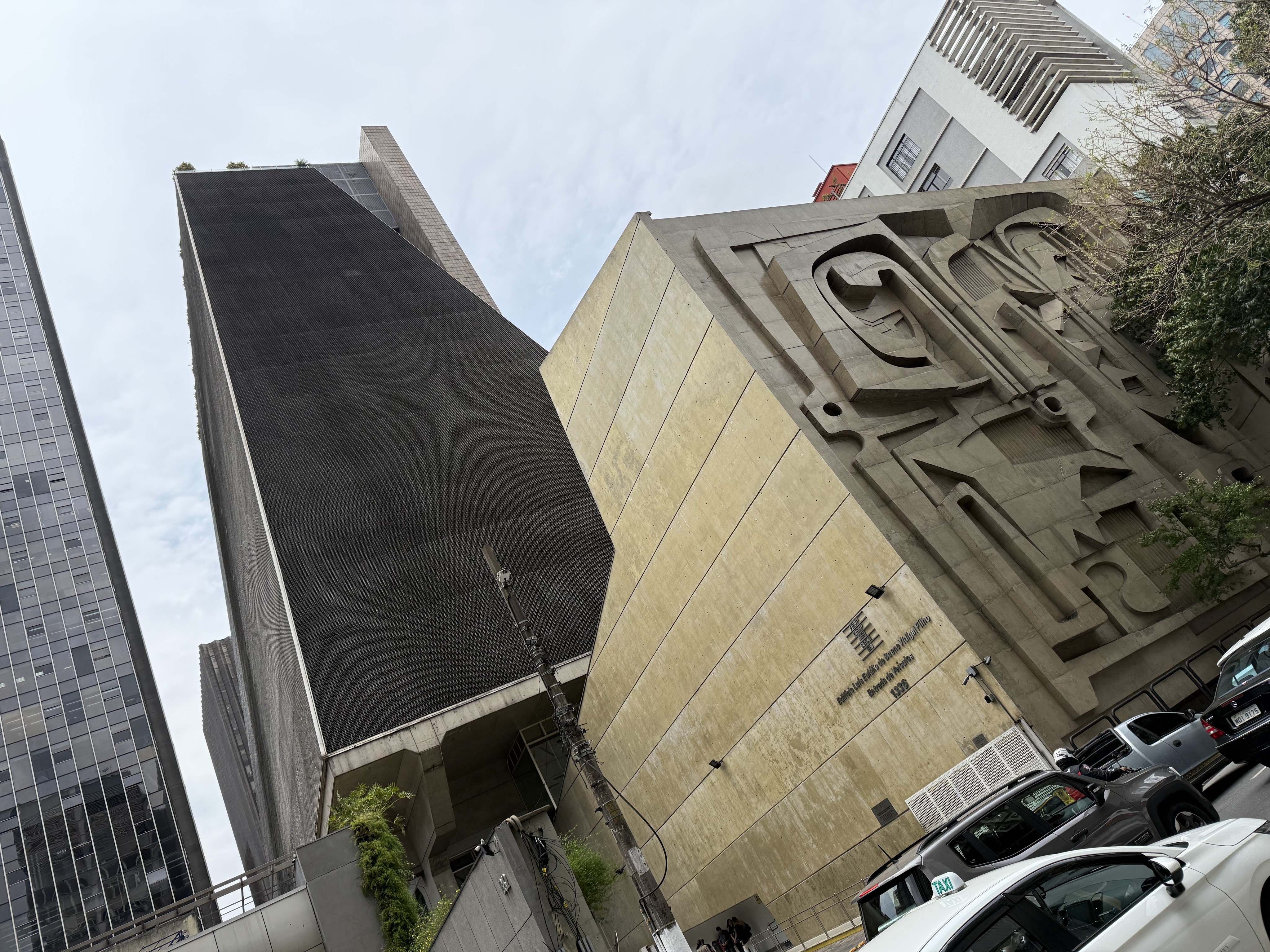
There’s no way I wouldn’t do a 360 on this place and its even more impressive from the other side.
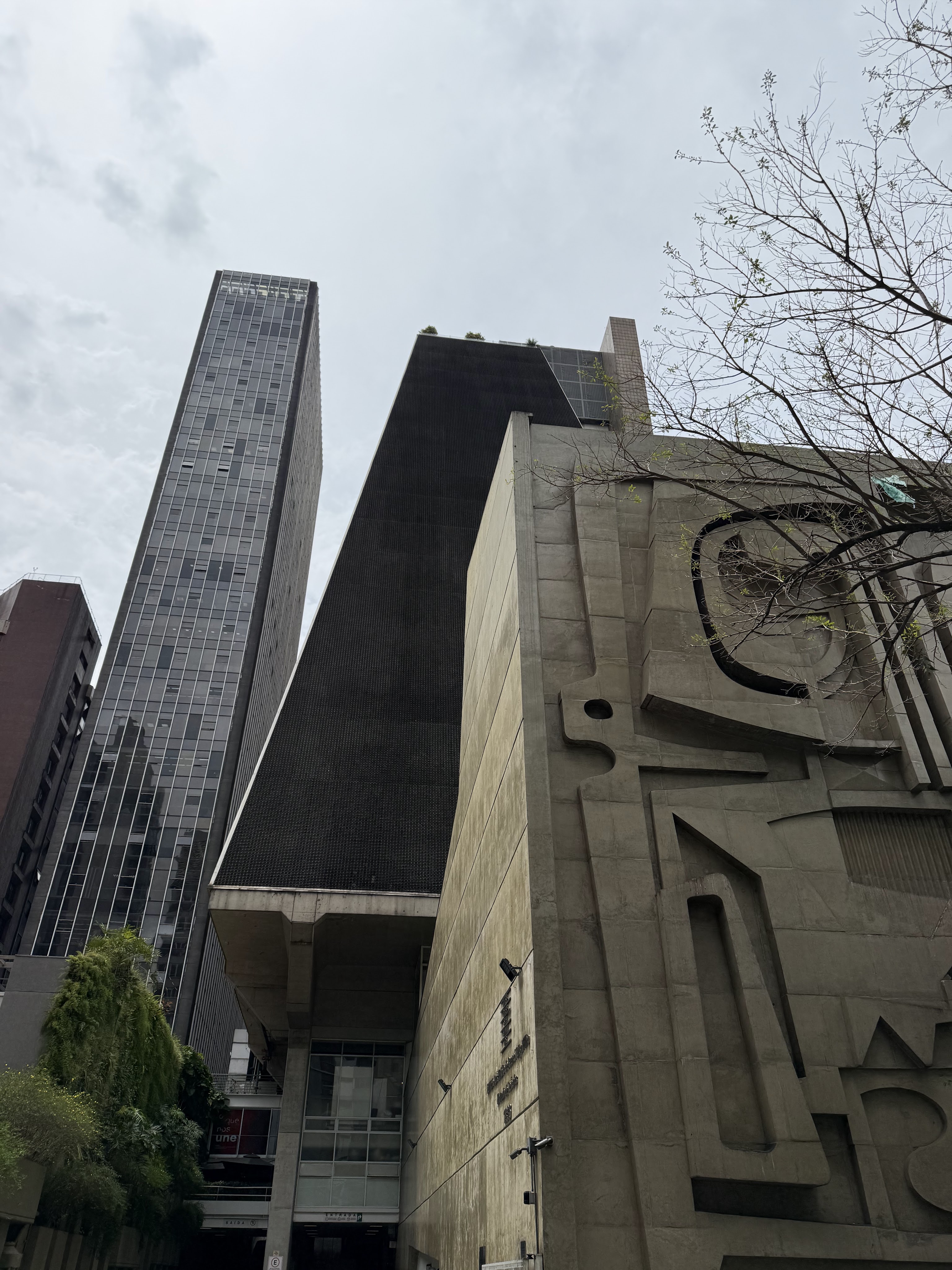
Behind the building, on the Alameda Santos entrance, there is a massive mosaic relief designed by the legendary landscape architect Roberto Burle Marx. It’s one of the largest hidden pieces of public art in the city.
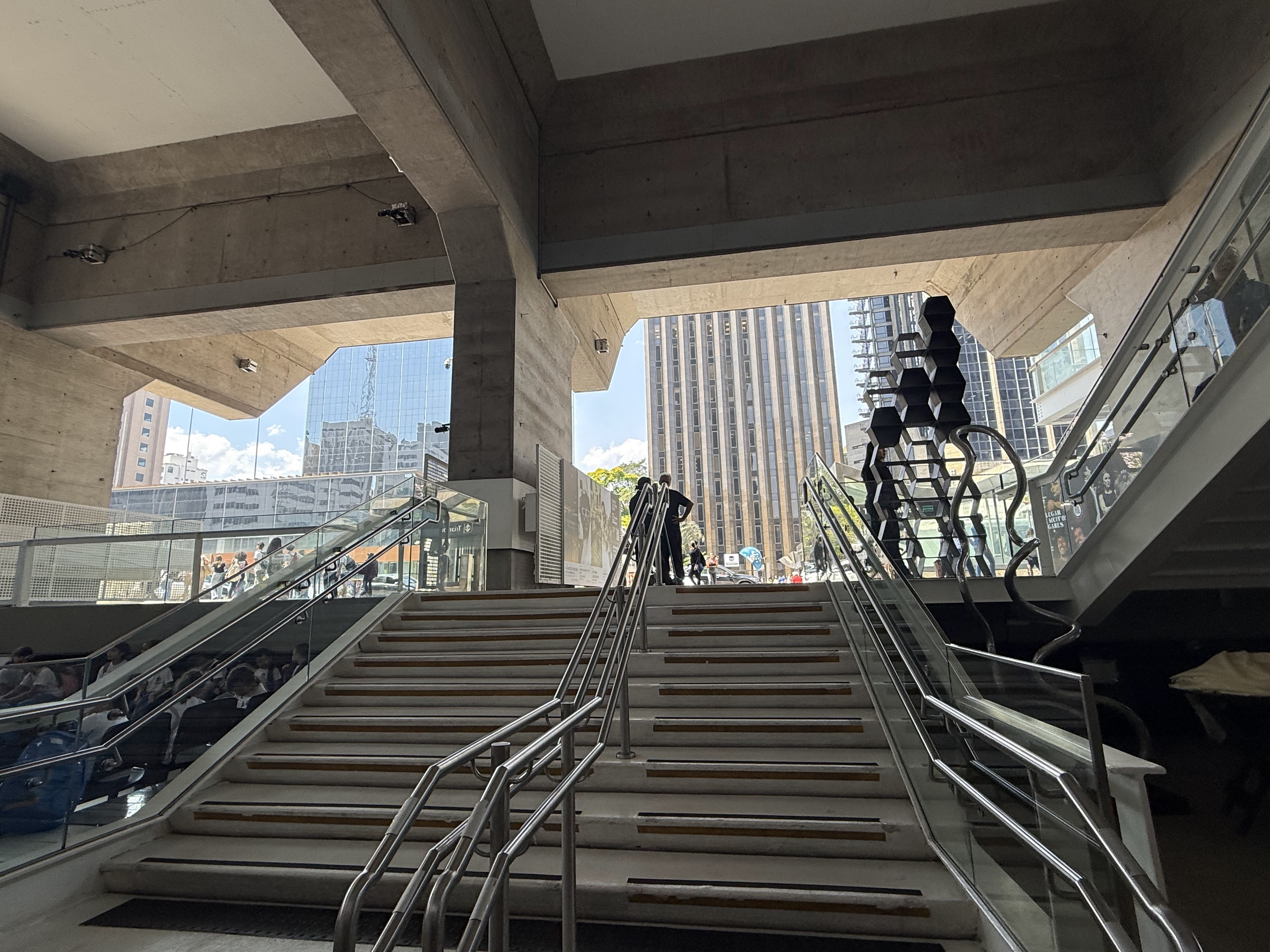
I actually returned to this building to get inside as the first time I went the publicly accessible spaces were closed. I wanted to know what was in that block and also maybe there was a chance to get to the roof too (no luck on the roof).
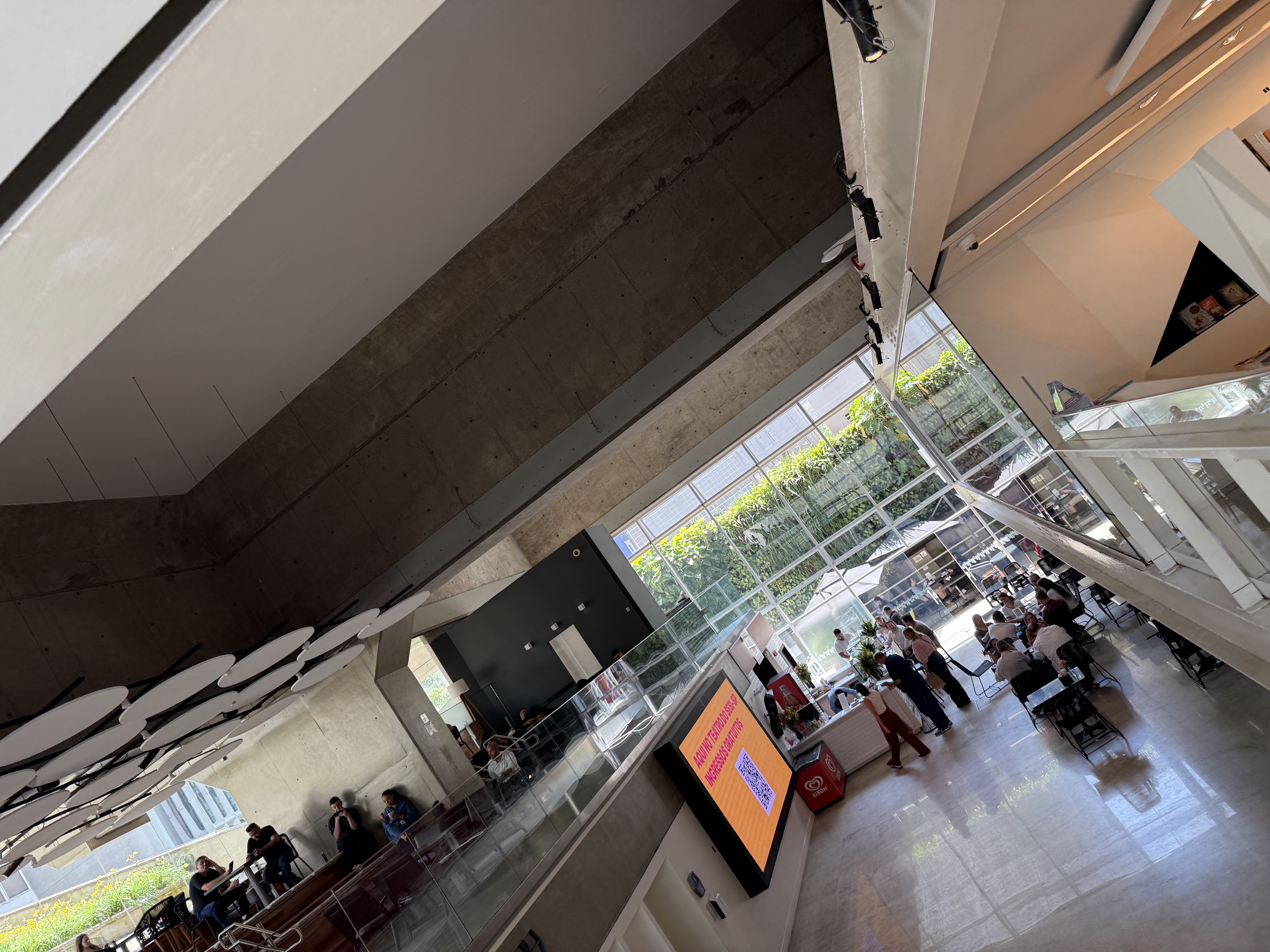
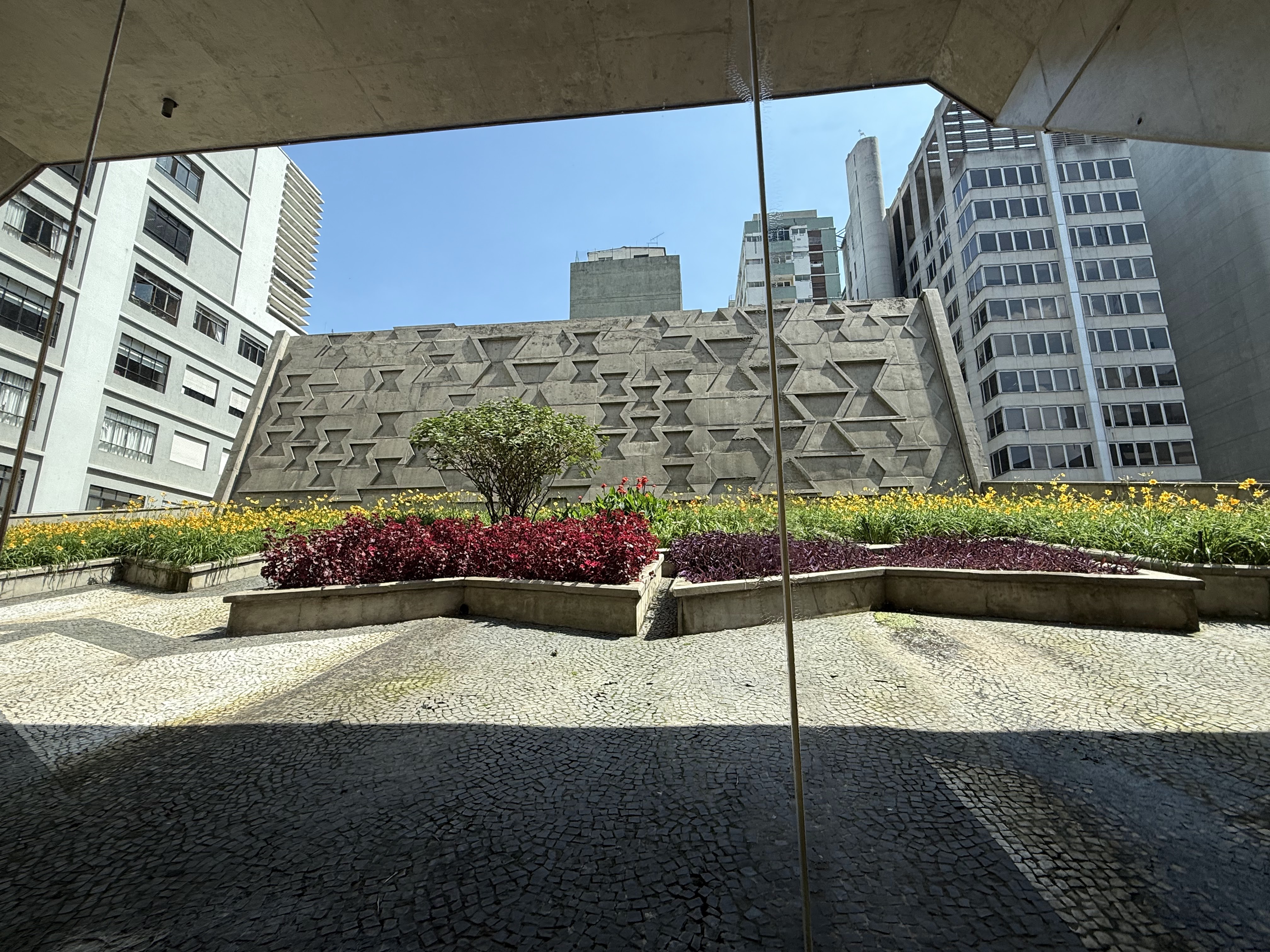
In the late 1990s, Paulo Mendes da Rocha was brought in to renovate the ground floor. Before his intervention, the building was somewhat fortress-like. Mendes da Rocha:
- Opened up the ground floor to create a cultural center (the SESI Cultural Center).
- Built a mezzanine and a theater.
- Restored the connection between the private building and the public sidewalk, effectively turning the “corporate pyramid” into a public destination.
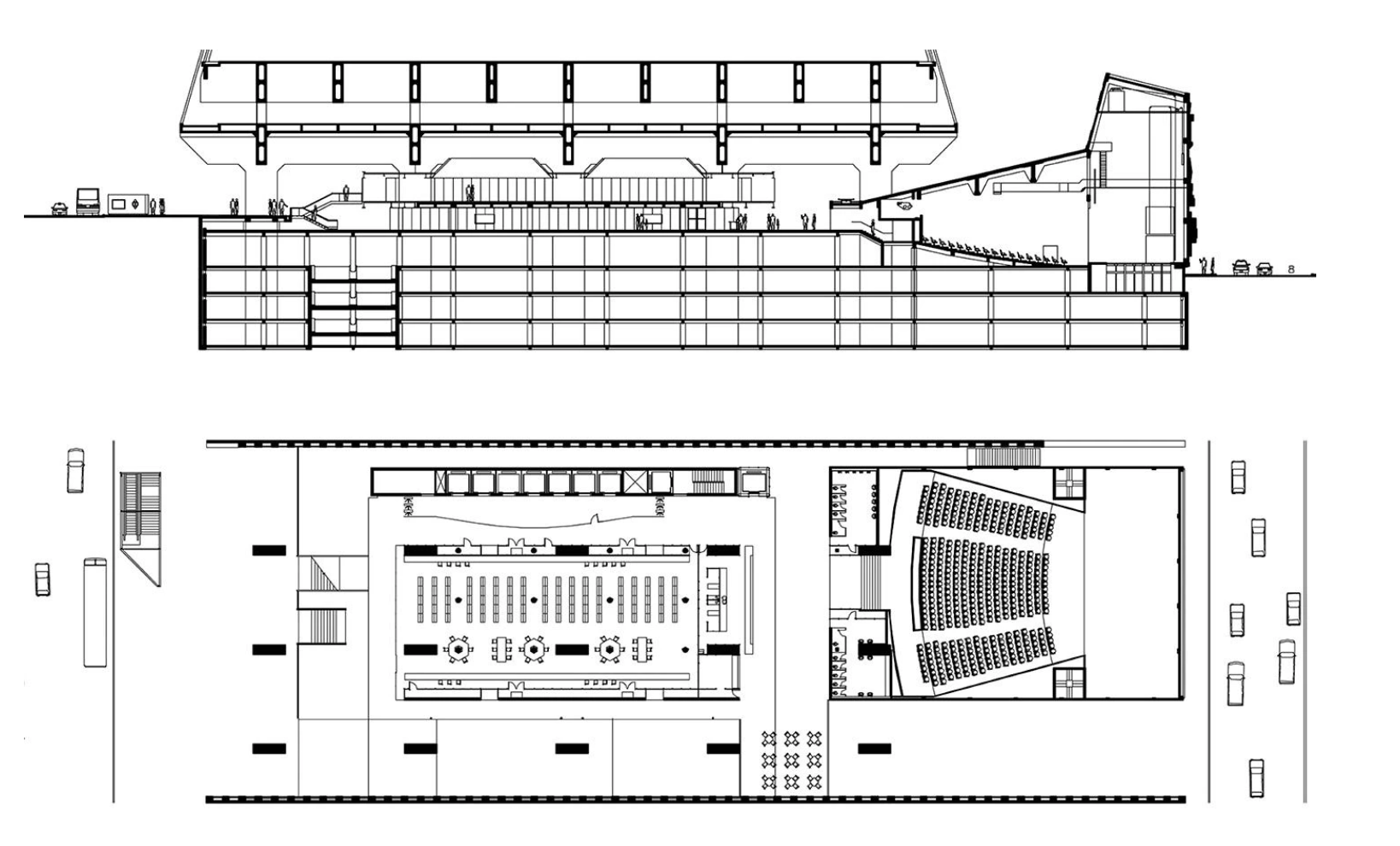
The book store and cafe were thriving and occupied- a variety of people studying, working, stopping in – this intervention seemed a success. Architectural drawings are representative of how incredible the human mind is- being able to represent 3D into 2D. The elevation and plans I found online deserved a screenshot here because 1) the internet is a lossy place (lossy being a word I’m confronted at work a lot right now), 2) they are just beautiful in and of themselves and 3) they explain a lot about what we can’t see.
1990s… that is well beyond the time of Brutalism in Europe which largely was from 1950-1970s… I considered Brutalism as a movement of the past when I was alive but in fact it was highly active in Brazil. But in my mind the 90s was already moving into these impossible shapes generated with computer software. I prompted Gemini on this “when did computer generated architecture start to get design and built in America and Europe” and my sense of timing was correct as the pioneer Gehry was already well at it – Guggenheim Bilbao was built in 1997. How ideas and philosophies spread- previously across the world over decades- now in an instant, driven by computers and servers and the internet but time is still time when it comes to experience.
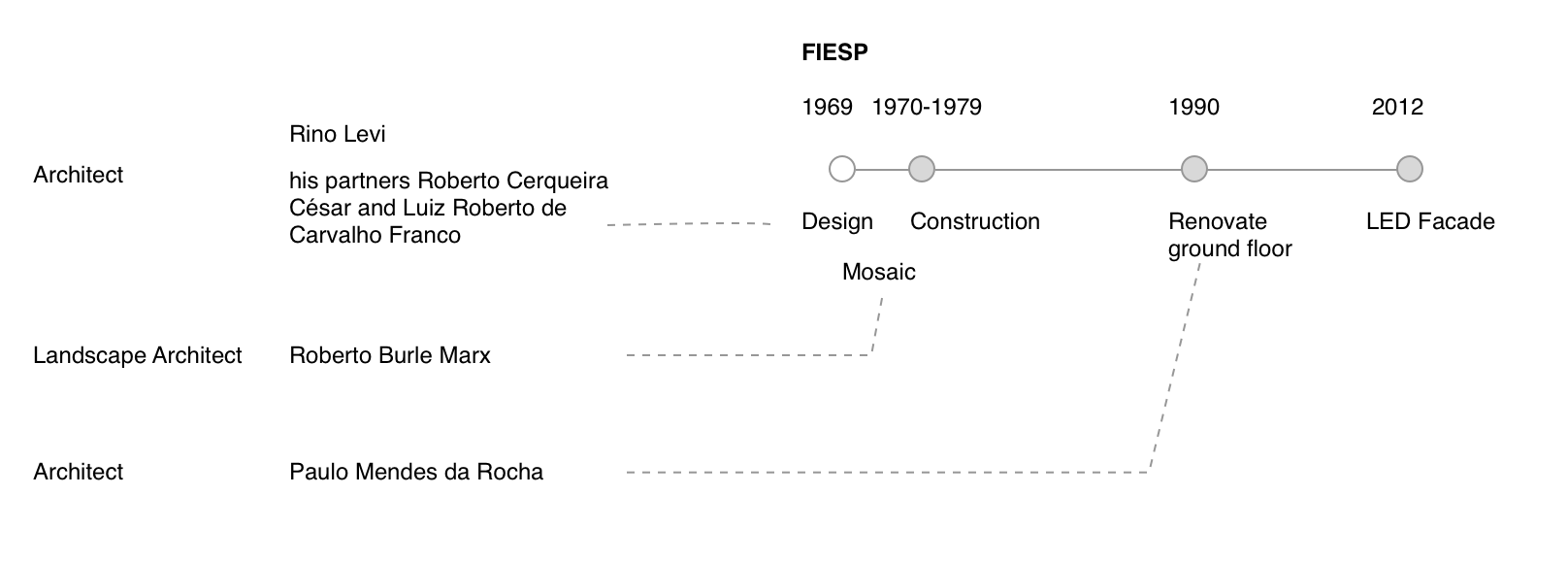
As a nod to time, I’ve come up with this idea to map out these São Paolo buildings and work out their relationships to each other. More to come on this…
I have a feeling that this is only the start of the research I will do and what I will learn as part of this exercise to write these posts. Already reflecting on my use of these LLMs- it is so quick to have well written summarized information spit back at me that it speeds up the relational work that I am eager to do. In all of this, who we are and what we believe matters a bit as we are still the ones who have to decide the question to ask. What do we want to know? What do we want to say to others? Will these machines want to know?
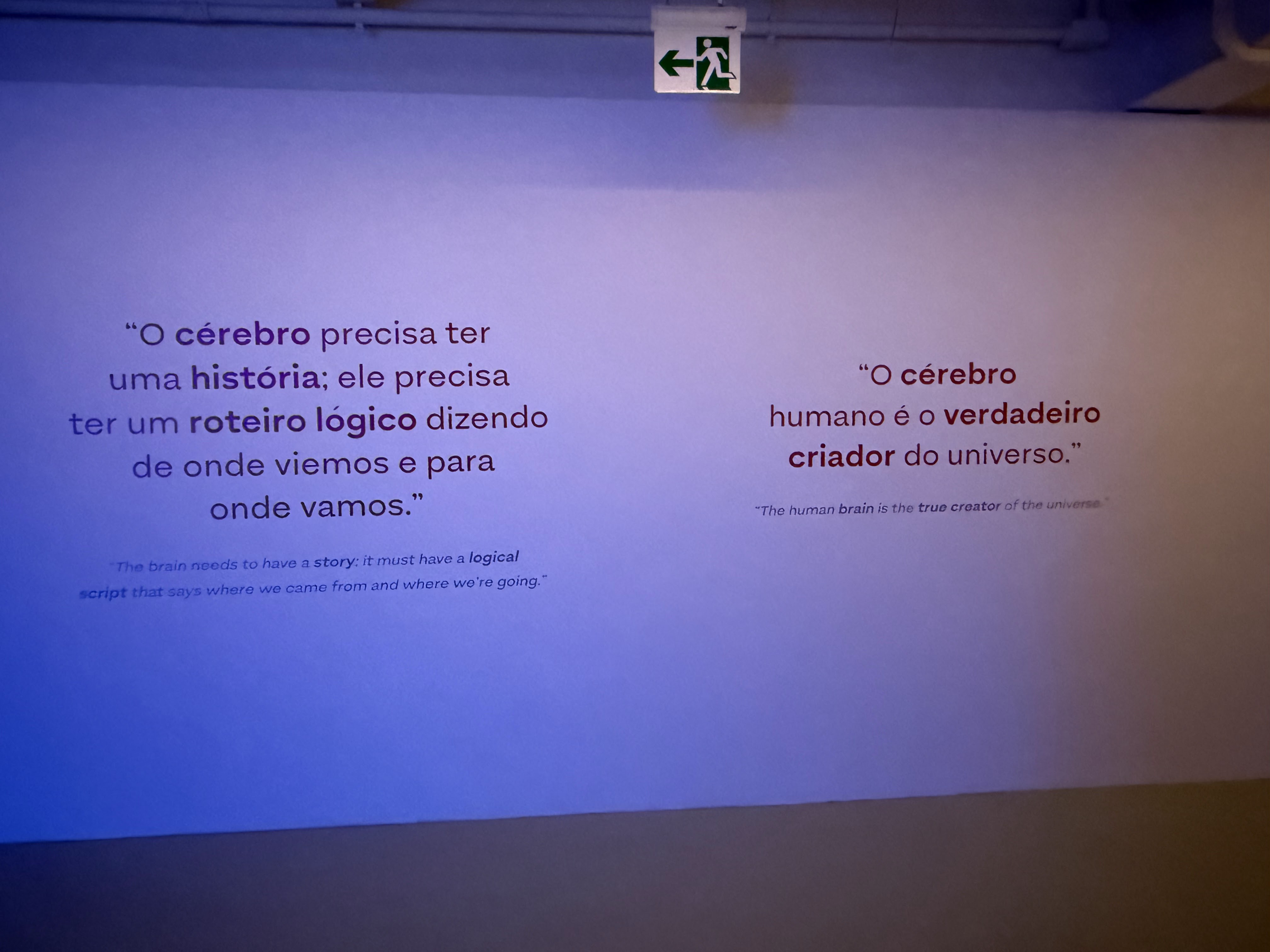
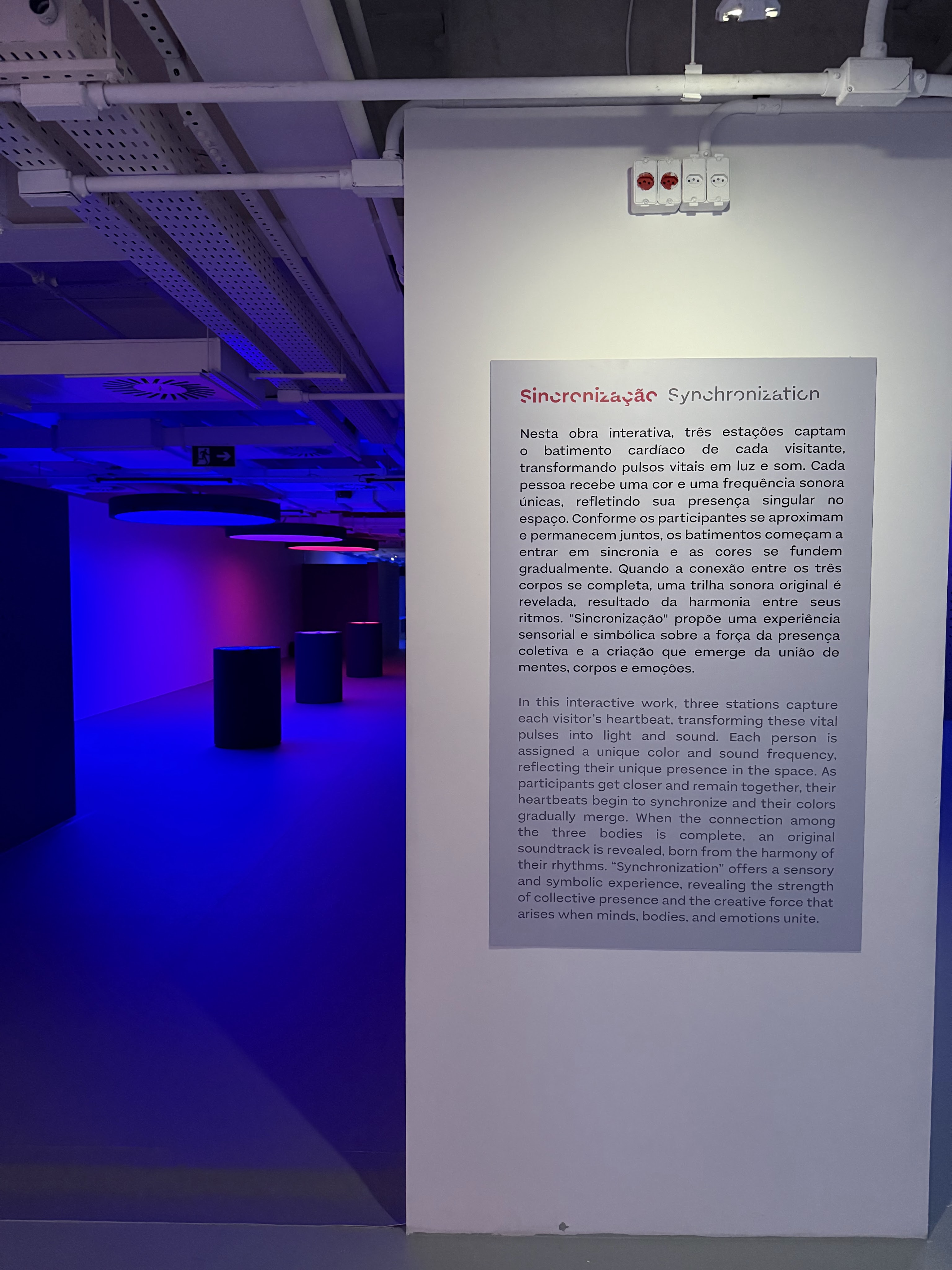
p.s. Speaking of relationships, there was a wonderful interactive exhibit in FIESP where heart rate monitors were provided whereby 3 people had to stick their finger into it and as their heart rates came together music was then generated and played to unite them. We have so many biological processes that we go unaware through our day with- it is a good reminder to get out of our heads and into our bodies.
Website: Architectura Viva write up
 ofallthespaces